


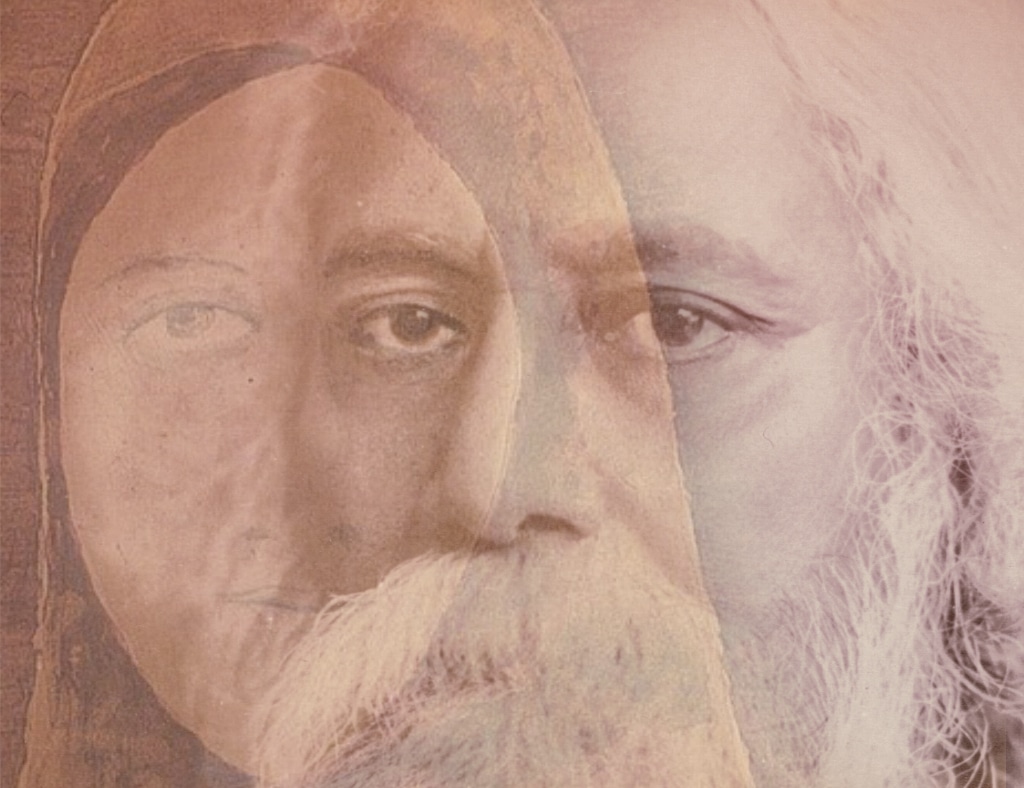

The month of Chaitra has a particular cruelty in Bangladesh. It announces its heat with a dry, pressing weight that makes the air feel like a punishment for something you cannot remember doing. Chaitra (the last month of the Bengali calendar) is the season when, locals joke, the sun decides to settle its old scores. That Tuesday afternoon in Khulna, it felt personal.
Just past one, Redwan, Nakib, and I stepped out of our car onto a rural road, and the heat hit us the way a wall hits someone who is not looking. The thermometer said 34 degrees Celsius. The air felt closer to 39. The car’s air conditioning, running all morning, had been doing cosmetic work. We were sweating through our shirts. Our backpacks sat heavy on our shoulders, stuffed with cameras, cables, notebooks, and deadlines, the usual baggage of freelance journalists on assignment.
We had not planned to stop. But somewhere between the morning’s interviews and the afternoon’s obligations, the three of us had silently agreed that we needed to exist outside our screens for a few minutes. To just be somewhere without purpose.
We found that somewhere at a tea stall by the road. A tong (a roadside tea shack), the kind that exists in every corner of rural Bangladesh with almost militant consistency: wooden benches scarred with cigarette burns, a man behind a portable stove, glasses of strong red tea brewed over open flame, and old Bangladeshi cinema songs playing softly. We sat down. The village men looked at us the way villagers always look at outsiders, with a quiet, unassuming appraisal that takes in your shoes, your accent, and your general energy before arriving at a verdict. We must have looked like city boys on holiday, though we were technically working.
We ordered tea and fell into the kind of conversation you only have when you are tired and slightly overheated and have nowhere to be for two hours. We asked the men about their days, their families, their kids. The sort of unnecessary talks that end up being the most necessary conversations of all. After a while, we all drifted to our phones. Redwan was checking something. Nakib was filming a short reel with his DJI Osmo. I was scrolling through the news. The village men sitting across from us were also on their phones, legs crossed, a cigarette each, faces tilted toward their screens with the same glazed ease. The digital world, it seems, has truly arrived in every tea stall in Bangladesh.
It was 1:37 pm when Redwan sent me a map link. No message. Just a pin.
I opened it. “Rabindranath Tagore Ancestor Residents and Rabindra Memorial Collection, Pithabhog, Khulna.” Seven kilometres away.
I looked up at him. “Do you want to go?”
He shrugged the way Redwan shrugs, which is to say, with great enthusiasm concealed under the pretence of indifference. “I mean, we have nothing for the next two hours.”
I turned to Nakib. He smiled, also on brand for Nakib, and began humming. Jodi tor dak shune keu na ashe, tobe ekla cholo re: if no one answers your call, walk alone.
We laughed. We called our driver.
Inside the car, Redwan declared that we were going to visit Rabi Thakur’s ancestral home, and therefore, with the solemn logic of a man who takes these things seriously, we were obligated to listen to Rabindra Sangeet (Tagore’s songs) on the way. I had the playlist. I scrolled and chose Shironamhin’s version of Gram Chara Oi Ranga Matir Poth, the classic Tagore song about leaving one’s village behind, reinterpreted by one of Bangladesh’s most beloved rock bands with just enough wistfulness to make it perfect for a drive through the countryside.
Redwan and I hummed along while Nakib turned the camera on himself and started narrating something for his vlog, the lens of his Osmo pointing at the window, at the road, at the trees blurring past. The rural landscape of Khulna in Chaitra does something to you if you let it.
The mustard fields are long gone by this month, and the paddy is either harvested or drying in stubble. What remains is a dense greenness. Mango trees still thick with leaves. Jackfruit hanging low like pendulums. The occasional flash of a pond between road and horizon, catching the sun like a coin dropped in the grass.
We reached the gate in about ten minutes.
It was a big gate, painted deep red, with white pillars and an inscription across the top in neat Bengali script: “Rabindranath Tagore Ancestor Residents and Rabindra Memorial Collection, Pithabhog, Khulna.” We stood there for a moment. Three journalists with phones and a drone, taking it in. There is something stirring about standing at the entrance of a place that connects to one of the greatest literary minds in human history, even if that entrance is a little dusty, and the paint is beginning to peel at the edges.
We walked in.
To the left was the memorial collection building. Locked, shuttered, sleepy in the afternoon heat. Ahead of us stretched a generous, open compound that felt like it had its own private climate. The trees were thick and old, knitting patches of shadow across the ground. And everywhere, mangoes. Small, unripe, bright green, lying scattered across the soil like an art installation no one had been invited to. Every few steps, another one. The mango trees here clearly outnumbered everything else, a fact that Aloka would later confirm for me with a proud smile.
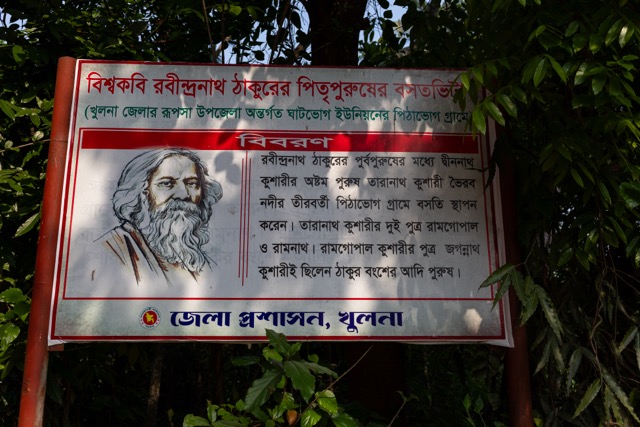
We did what curious people do when they find an unlocked, open, historically significant space in the middle of a warm afternoon. We wandered. We read the wall writings, mostly history, dates, names, the kind of inscriptions that give you the skeleton of a story without the flesh. We peered through the grills of the memorial building like cats who had found a door that was almost, but not quite, open enough. Nakib filmed. Redwan pulled out his drone and began setting it up with the focused energy of a man on a mission. I circled the premises, hands in pockets, looking for something I could not quite name.
After a while, we sat down in the shade. Nakib and I lit cigarettes. Redwan was crouched over his drone, muttering to himself the way he does when something is not calibrating.
I spotted a teenage boy walking through the premises and waved him over. He came barefoot, with the long, unhurried stride of someone who had nowhere particular to be.
“Do you know when this place opens?” I asked. “We’d love to go inside.”
He pointed toward a house beyond the compound boundary. The kind of house you see in older Kolkata films. A single storey structure with a deep porch and clay walls, the kind that feels like it has been growing out of the earth slowly for decades. “The people who keep the keys live there,” he said. “If you go and ask, they’ll open it for you.”
Nakib and I looked at each other, stubbed out our cigarettes, and walked over.
There were two women visible from the path. One was elderly, sitting near the entrance of the house, her white sari arranged around her like a settled cloud. The other was younger, perhaps in her mid-thirties, and she stepped outside before we even reached the gate, as though she had been watching for visitors.
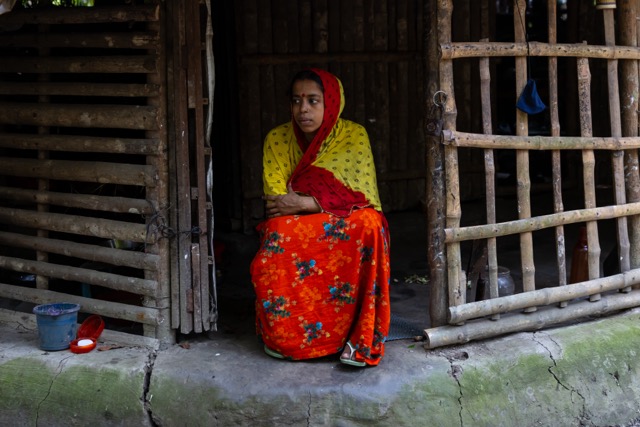
She smiled at us first. That was the thing I noticed. It was not the cautious smile of someone sizing up strangers. It was warm and immediate, the smile of someone who had been waiting, not necessarily for us, but for anyone who had come with curiosity and good intentions.
“Are you here to see the memorial?” she asked.
“Yes,” we said.
“Wait,” she said, already turning back inside. “I’m coming with the keys. We keep them close by. Whenever someone comes, we open it. Otherwise, the place gets dirty and muddy.”
I told her we understood. I introduced ourselves. I was Nayem, this was Nakib, and our friend Redwan was back at the memorial with his drone. We were journalists from Dhaka, here in Khulna for other work, and we had found this place by accident, by a map link, at a tea stall, because of a slow afternoon.
She nodded and told us her name.
Aloka Kushari. The seventeenth generation of Rabindranath Tagore.
I did not visibly react, but something shifted in the air. Or in me.
Before we could properly respond, we heard the old woman from the porch call out, in a slow, emphatic voice, “Wait!”, and she began making her way toward us. She moved with the deliberate care of someone who has long since negotiated a peace with her own pace. When she reached us, she was smiling, her smile entirely toothless and completely radiant.
“I am Sayarani Kushari,” she announced, with the formality of someone presenting credentials. “I am more than ninety years old. I am Aloka’s mother-in-law.”
Aloka smiled beside her and leaned slightly toward us. “She’s closer to a hundred,” she said quietly, with the patient affection of someone who says this often. “She forgets things sometimes, loses track. But she always wants to come when visitors arrive.”
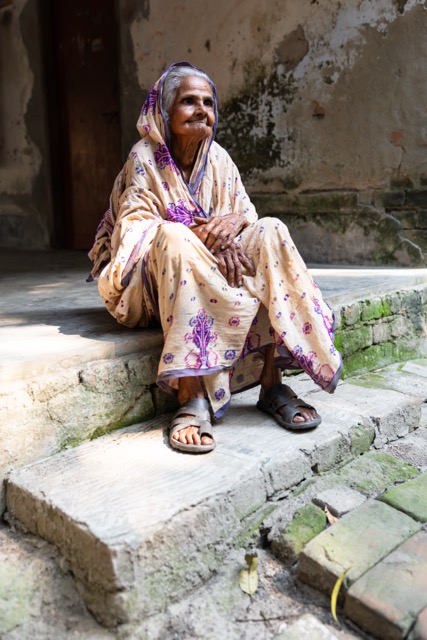
Sayarani Kushari stood there in the heat of a Chaitra afternoon, the sixteenth generation of one of the most significant figures in Bengali and world literature, presenting herself to three strangers with the easy dignity of someone who has long made peace with who she is and where she comes from.
There was nothing performative about it. She was here, as she had always been here, as her family had always been here, tethered to this land and this name across nearly a century of her own life.
We nodded as if it were perfectly normal, because in that moment, somehow, it felt like it was.
Aloka unlocked the memorial and led us in, speaking with the practised ease of someone who has given this tour before but still finds meaning in it. The room held photographs in dark wooden frames, documents under glass that had begun to yellow at the corners, and a small collection of objects. The material evidence of a family’s connection to literary history. The air inside was cooler, faintly damp, the smell of paper that had lived through many monsoons.
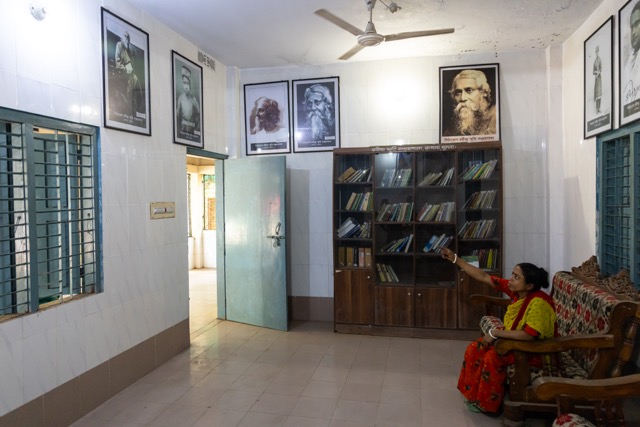
Redwan and Nakib moved through it with appreciation, pausing at photographs, squinting at inscriptions. Eventually, Redwan’s drone beckoned him back outside, and Nakib followed with his camera.
That left Aloka and me standing in the middle of the room, the afternoon quiet around us.
I asked her, the way you ask about something that feels important without being sure why, “When did people first know about this place? That it was connected to Tagore?”
She thought for a moment, then answered with the precision of someone who has turned this story over in her mind many times.
“It started in 1995. Before that, no one knew we were part of the Tagore family. There was just an old, damp building. Water always dripping from the ceiling. The walls going soft. Then one day, people from Bagerhat Adorsho Maddhamik Biddalaya came here with documents. They had been doing research and wanted to prove that this land was part of Rabindranath Tagore’s homestead. My mother-in-law was there during that conversation in 1995. She remembers it.”
Aloka paused.
“After that, people started digging deeper. They found the proof.”
She tilted her head slightly, her expression shifting to something closer to delight. “Do you know,” she said, “that Tagore isn’t actually our family title?”
“No,” I said, honestly. “I didn’t know that.”
“People called us Tagore out of respect. A kind of honorary title. But our real lineage is the Kushari family. We have always been Kusharis.”
She said it the way you say something that feels like a correction and a reclamation at once. The Tagore name, the one that won the Nobel Prize, the one that filled schoolbooks and concert halls and national anthems across two countries, was a name the world had given. The Kushari name was the one they had always kept for themselves.
We walked the premises as she talked, looping slowly through the shade of the mango trees, the occasional jackfruit hanging low over our heads like a warning. She told me about her husband, Barun Kushari, the seventeenth generation, like her, who works at the local Khulna Museum in a curatorial capacity. The Archaeology Department had offered him the position when the family’s lineage was officially confirmed. The salary, she said, is low. The government gives them 1,500 taka per month through the local Thana Nirbahi Officer or TNO (the chief administrative officer of an upazila). Roughly thirteen dollars. Enough for very little.
“We don’t receive any significant incentives,” she said, and her voice carried no bitterness, only a matter-of-fact tiredness. “As you can see, we are poor. It’s hard sometimes.”
She pointed toward the far end of the compound, where a modest poultry enclosure sat behind a low fence of bamboo and wire. “That’s why we do poultry.” She smiled, then the smile shifted into something more complicated. “You know, people used to say things. That a Brahmin family shouldn’t run a poultry farm. That it wasn’t proper for who we are.” She paused. “But when your back is against the wall, you do what you have to do. We have children. We have a life. You do everything to ensure your livelihood.”
There is a particular kind of dignity in that sentence. You do everything to ensure your livelihood. I kept turning it over in my mind as she spoke. Here was the seventeenth generation of Rabindranath Tagore’s family, descendants of Debendranath Tagore’s branch, living on a small plot of land in Pithabhog, Khulna. Raising chickens. Opening the memorial museum whenever a stranger happened to find their way here by a map link on WhatsApp.
I asked her about the land, and she brightened, the way people do when they get to talk about something they love.
“We have more than fifty mango trees,” she said. “All different kinds. Fazli, Aam Rupali, Himsagar, Madhugulguli. And jackfruit, coconut. I’ve lost count of everything.” She gestured around us with the proprietorial ease of someone who knows every inch of a place, every root and rise. “It’s peaceful here. Very green.”
She took me to the pond at the southern edge of the property. A wide, still body of water, half shaded by trees, its surface broken only by the occasional dimple of an insect landing. There had been a legal dispute over it, she told me, and they had lost the case. She did not elaborate, and I did not push. She just stood there, looking at it, with the expression of someone cataloguing a small, particular grief.
“We used to play there as kids,” she said finally. “Fall in, climb out, fall in again.” She laughed, a short, bright sound that startled a bird from the branches above us. “Good memories.”
I asked, carefully, about visitors. Whether people from Kolkata or India had ever reached out, offered support, or made a connection across the border.
She nodded.
“People from Kolkata and India visit sometimes. For the history, for the connection. They come, they look around, they take photos.” She paused. “No one has offered any help. But honestly?” She looked at me directly. “We don’t need help. We are happy with what we have. We feel proud, genuinely proud, to belong to this family.”
When she said that, I felt something prickle at the back of my neck. It was not pity. It was not admiration exactly. It was something closer to recognition. The kind you feel when someone says something entirely true and entirely unexpected at the same time. Later, writing this, I felt it again.
The Tagore name, in Bengal, carries the weight of an entire civilisation’s self-understanding. It is in the national anthems of both Bangladesh and India. It is in the songs that children learn before they learn mathematics. It is in the poetry that lovers quote to each other across generations. And here, in Khulna, Pithabhog, in a compound of mango trees and a locked memorial museum, the seventeenth generation was raising chickens and opening the gate for strangers and saying, we are happy with what we have, we feel proud to belong to this family, and meaning it without irony, without performance, without the slightest suggestion that they required your sympathy.
That is the most aristocratic thing I have heard anyone say in a long time.
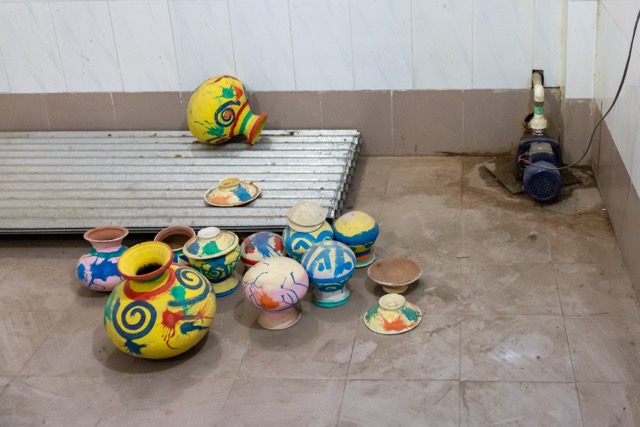
Aloka mentioned the annual Rabindra Jayanti celebration, held on the 25th of Baishakh (May 8th in the Gregorian calendar). This year, the program was scheduled across three days. The 8th, 9th, and 10th of May, running from eight in the morning until half past ten at night.
“We start in the early morning with Prodip,” she explained. The ceremonial lighting of lamps. “Then pigeon flying. People come from Khulna Shilpakala, Shabuj Academy, local government officials, and school children with their teachers. People even come from Dhaka sometimes.” All day, they sing Rabindra Sangeet. Children hold drawing competitions, crouched over sheets of paper held down with stones against the breeze. People recite Tagore’s poetry. There are theatrical performances of his plays and stories, staged in this compound, under these mango trees, in the shade of a place that remembers him through blood rather than marble.
She looked at me with an expression that was partly an invitation and partly a question.
“Why don’t you and your friends come? For the 8th of May? We would love to have you.”
I told her we were leaving Khulna on the 6th of April. That we had work to deliver in Dhaka, that we had come here by detour and could not stay. She looked, briefly, like she had when I asked about her husband’s salary, a small shadow crossing her face before the composure returned.
“Maybe next year,” I said.
Redwan’s voice came from across the compound. “Hey, it’s almost 3:30. We have to go.”
I turned back to Aloka. The afternoon had tilted past the harshest part of its heat, and the light through the mango trees was beginning to take on that golden, late afternoon quality that makes everything in rural Bangladesh look as if it had been painted by someone who was trying hard.
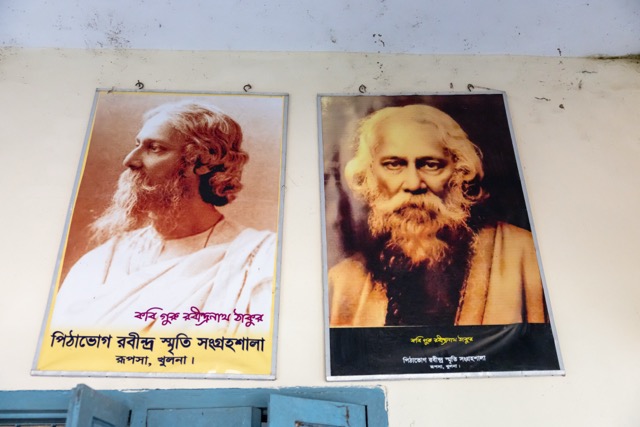
Sayarani Kushari was sitting near the memorial entrance, watching the three of us with the long, calm patience of someone who has seen many visitors come and go.
Aloka offered us lunch. I wanted to say yes. The kind of yes that comes not from hunger but from not wanting to leave a place that has given you something you did not know you were looking for.
But there was a deadline, and a driver, and Dhaka waiting at the end of the road.
I asked to take a few photographs. She agreed with a smile, smoothing the edge of her sari almost without thinking. I took ten minutes. Not enough, but something. Then I walked back toward the gate, past the mango trees, past the scattered unripe fruit on the ground, past the locked memorial with its grille through which we had peered like curious cats just two hours earlier.
We drove away. I put on Gram Chara Oi Ranga Matir Poth again.
Redwan was quiet. Nakib was reviewing his footage, the small screen of his Osmo glowing in the dim of the back seat. I looked out the window at the Khulna countryside rolling by in the heat and thought about a woman in her mid-thirties standing in a compound of mango trees, holding a ring of keys, describing her life with the quiet ease of someone who has decided to be exactly where they are. No more, no less.
I am writing this on the 7th of April, a month before Rabindranath Tagore’s birth anniversary, with the same song playing in the background. On May 8th, Aloka Kushari will light a lamp at dawn. Pigeons will scatter into a Khulna morning sky. Children from local schools will arrive with their teachers, a little shy, a little excited, their shoes still dusty from the walk. Someone will sing Amar Shonar Bangla, the national anthem Tagore wrote for the country. People will recite his poetry in the shade of mango trees.
The seventeenth generation will be there.
The eighteenth will be somewhere nearby, growing into their inheritance.
And the sixteenth, Sayarani Kushari, nearly a hundred years old, toothless and smiling, will probably walk out slowly to greet the visitors, because she always does, because she has always done, because some habits are less about habit and more about who you are.
We feel proud to belong to this family.
I keep returning to that sentence. I will for a while.
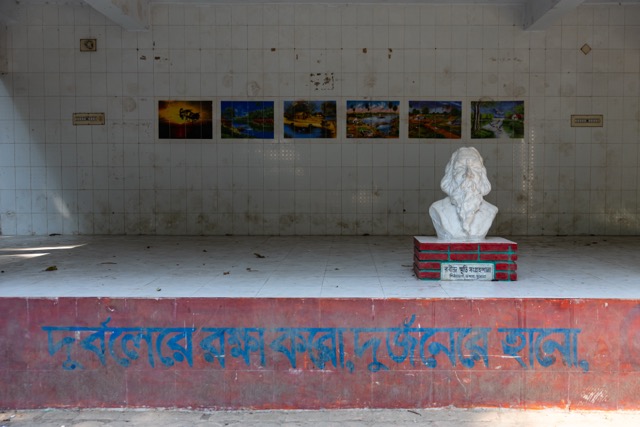
The Rabindra Jayanti program at Pithabhog, Khulna, will be held on May 8, 9, and 10, 2026, from 8 am to 10:30 pm daily.