




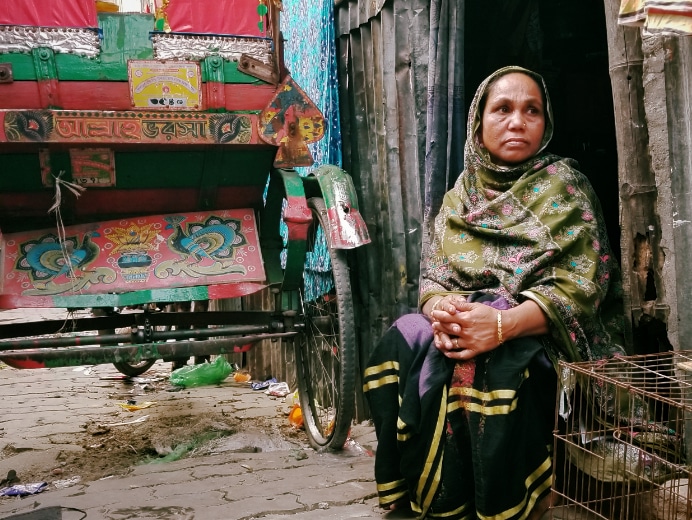
It was noon when I reached the Kalyanpur slum. Nilufar Begum had finished cooking, taken a bath, and sat at the door of her single room house. No one else was home, though her family of six all share that room. Her son (36), who has cancer, had gone to the Mohakhali National Cancer Hospital. His wife and their three children had gone to her parents’ house in Comilla.
What did she cook today? I asked. Only kalmi shak bhaji (stirred greens) and lentils, she said.
Nilufar Begum is 53 years old. In 1973, when she was two, the Meghna River swallowed their home in Bhola. She came to Dhaka holding her mother’s hand, together with her two sisters.
She spoke fondly of her early days in Dhaka. They lived in a slum next to the Mohammadpur embankment. “When I came to Dhaka in 1973, we struggled for food. We knew no one. My mother and my two sisters were in danger. I was the youngest. My mother started working as a domestic helper in people’s houses. We ate whatever food the householders gave us. Sometimes we would ask people for food. When I grew up, my mother enrolled me in a school. But I could not continue because of money.”
Career at seven
Nilufar started her career at seven. Even as a child, she worked as a domestic helper because the family had no money. “But at that age, I did not like working. I told my mother, I won’t stay here, take me away. Then my mother said, if you don’t stay here, what will you eat? How will I feed you?”
The householder had another child the same age as Nilufar. “I worked and took care of that child. I played with her. They were both husband and wife doing jobs.”
First victim of harassment
Nilufar worked in that house in Mohammadpur for a year. She was eight at the time. When the owner left Dhaka with his family, she lost that job. Her mother found her a new position as a domestic helper in the Asadgate area. That was where Nilufar first suffered abuse. “They gave me hard tasks: sweeping the house and washing dishes. But I was young, so I could not do them well.” The owner dismissed her.
A construction worker’s life
When Nilufar was nine, her mother pulled her from domestic work and took her to break bricks at a construction site. Her mother also worked as a bricklayer. Together they broke bricks to earn money for the family. She told us about an accident during the construction of a road near the agricultural market in the Mohammadpur area. “One day, I was breaking bricks when a hammer fell and crushed my hand. I cried. Then my mother told me, ‘You don’t have to work here anymore. You just sit here.’” Later, Nilufar took another domestic helper position in the Adabor area.
Child marriage
When Nilufar was twelve, she started selling pitha (rice cakes) on the sidewalk: bhapa pitha (steamed), patishapta pitha (rolled), and chitai pitha (thin, crisp). She fell silent when she came to the hardest days. She stood, drank a glass of water from the dark room, and returned to the door.
Her eyes were wet. “Our life is difficult. We have suffered so much that we cannot tell anyone. And even if we tell, no one will believe us.”
At twelve, she was forced into marriage. Her husband, Anwar Hossain, worked in a small food shop. He had seen her selling pitha and liked her. He took her away without telling her family, then married her. Nilufar’s family searched everywhere. They went to the Mohammadpur police station and prepared to file a missing person’s case. After a week, Anwar brought her back. “I cried. I told my husband, why did you kidnap me and force me to marry you? Take me to my mother.” Her mother was relieved to see her daughter. She had never consented to the marriage. But they had no choice.
The hardest days
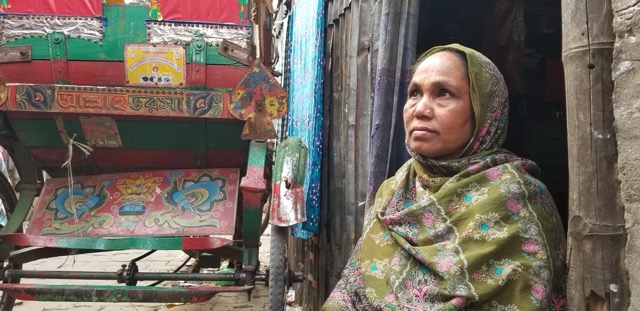
Nilufar’s husband did not want to work. They had no place to stay. Her mother gave them a small space next to her house in the Mohammadpur slum. Nilufar worked as a domestic helper and held the family together with great difficulty. Their first child died a few months after birth.
Her eyes grew wet again as she spoke. She wiped them with the hem of her saree. “If the Meghna River had not destroyed everything for us, we would not have come to Dhaka. We would not have suffered like refugees.”
“When I think of my history, I cannot hold back my tears. How difficult our lives have been. I could never buy a fish to eat. I could never wear a new dress. I cried behind my mother. She would say, where will I get new clothes for you? Your father does not work. Where will we get the money?”
Nilufar’s voice choked with tears.
The 1988 flood
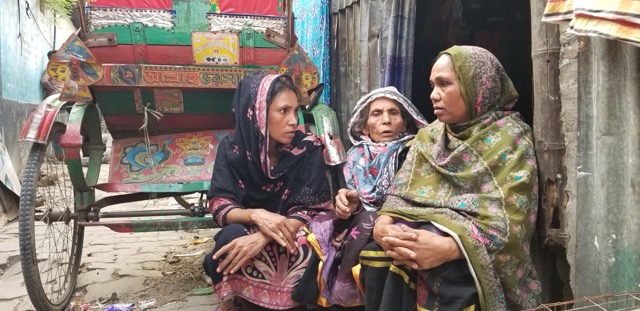
As she spoke, her mother Anwara and younger sister Shahana joined her. Nilufar’s other sister was born after the family came to Dhaka. They live in the next lane in the Kalyanpur slum and had come to see their sister.
During the 1988 flood, the family fell into great hardship. Nilufar was pregnant with her second child. She, her husband, mother, father, three sisters, and her elder sister’s daughter (eight people) took shelter at a center on Iqbal Road in Dhaka. “In the flood, all the houses in our slum went under water. My parents, sisters, and my husband, the whole family, stayed there for two months. I had my second child there. His name is Roni.”
After the flood: Kalyanpur slum
When the water receded, Nilufar’s family crossed to the empty land opposite Government Bangla College in the Kalyanpur area and built a house. They put together a few flimsy shelters from scraps of wood.
Nilufar said the slum caught fire in 1989, the year after the flood. Everything in their house burned to ashes. Her family barely escaped. Nine residents died in that fire.
“When everything was gone, we started living here again with a polythene roof. We did not have the money to build a house with tin.”
After the fire, Nilufar had no money to move. She sighed. “Our economic situation had become bad. We did not have the money to go to the market. I would go to the market in the morning and bring abandoned raw vegetables from the street. Then I would cook the cauliflower leaves and eat them. We would go without food for two meals.”
Her mother and sister shed tears. Memories of suffering passed before their eyes.
They have lived in this Kalyanpur slum for 36 years since 1988. The slum has burned four times and been demolished six times by miscreants. Over the years, Nilufar saved enough to buy tin for her house.
Garment work
When her husband did not earn, Nilufar took a job at a garment factory through a relative. She cut cloth yarn. The salary was 12 takas. “At that time, garment factories did not pay salaries on schedule. If they paid for one month, they would keep three months in arrears.” Since the income was not regular, she returned to domestic work.
The cycle of child marriage
Nilufar has three daughters and one son. After educating the eldest daughter to class five, she could not afford more schooling. She married her off at twelve.
The middle daughter passed the SSC examination. Then she could not continue. Nilufar married her off at sixteen.
The youngest daughter completed class ten and married at fourteen. Her husband is paying for her to continue studying.
When I asked why all three daughters married young, Nilufar gave a frank answer. In slums, parents marry off their daughters early for safety. She spoke in a cautious whisper: “All kinds of scoundrels disturb them. Unmarried girls cannot be kept in slums for long. Even if young men are warned, it makes no difference. They threaten to kidnap the girls.”
The endless suffering
Nilufar said they never wanted to come to Dhaka. But when the Meghna River took everything, they had no choice. “Our difficult life sank into more difficulty after coming here. We gained nothing. Our lives did not improve. We burdened ourselves with new suffering.”
Her mother nodded.
Now Nilufar has six people in her family: herself, her son, his wife, and their three children. Her son has cancer. Her husband died last month from a heart attack after hearing about the diagnosis. The family has no other income. She borrows at steep interest to treat her son. “I am 53 years old. At this age, people live a secure life. I still walk the streets selling clothes to earn handfuls of rice. If I stay at home for a day, the food will be gone.”
“We have been in Dhaka for 51 years. But there has been no improvement. We still work hard to earn two meals a day. We don’t even have a place to bury ourselves if we die.”
Nilufar was sitting at the door of the house, crying, as she said these words. Her mother and sister had tears in their eyes too. By then, evening had fallen. Nilufar went to light a lamp. But there is no light in the lives of these climate migrants.
Climate migrants in Bangladesh
Bangladesh is one of the most climate vulnerable countries in the world. In 2022, over 7.1 million Bangladeshis were displaced by climate change, according to the World Health Organization. A World Bank report projects Bangladesh could have 13.3 million internal climate migrants by 2050. Atiqul Islam, then mayor of Dhaka North City Corporation, said around 2,000 people move to Dhaka each day, 70% because of natural disasters and climate change.
COPs and neglected climate migrants
I asked Nilufar whether she had heard of COP (Conference of the Parties, the annual UN climate summit where world leaders negotiate action on climate change). She looked at me in surprise. She does not know what COP is. This is the first time she has heard the word. She knows nothing about any conference.
She does not need to know what a COP is, because no one cares about poor climate migrants like her. WHO materials around COP29 mention migration, displacement, and migrant health, but no standalone COP29 declaration or funding package has emerged for climate migrants alone.
Experts’ opinion
Harjeet Singh, a climate activist and Global Engagement Director at the Fossil Fuel Non-Proliferation Treaty Initiative, said: “Bangladesh or India or Nepal and many other countries are endangered because of sea level rise or because of glacial melt. Certain places are going to be uninhabitable. In that situation, people have to move, and we must respect their right to move, but then we need to provide them with support when they are migrating. There are also challenges with the host community, because cities in our part of the world are not ready to receive migrants.”
Singh added: “Insufficient support has come to climate migrants in the form of adaptation. We are looking at a challenging situation, and we do not have a proper policy framework in developing countries to deal with it. There is no support coming from developed countries to help them develop that framework and help people forced to migrate. The situation is getting worse with increasing climate impacts.”
Md Shamsuddoha, Chief Executive of the Center for Participatory Research and Development (CPRD), said: “Migration from rural to urban areas is growing. Urban areas should welcome migrants. They should develop the capacity to hold people and to provide essentials: water, education, health, and livelihood opportunities.”
He added: “Developed countries should take responsibility for migrant people. But it is difficult, because developed countries will not accept responsibility for migrants in the name of climate change. They may consider labor migration, but they will not take responsibility for climate migrants. That is why we need to accommodate our people who migrate within the country, ensure their job security and food security, and provide essential services.”