


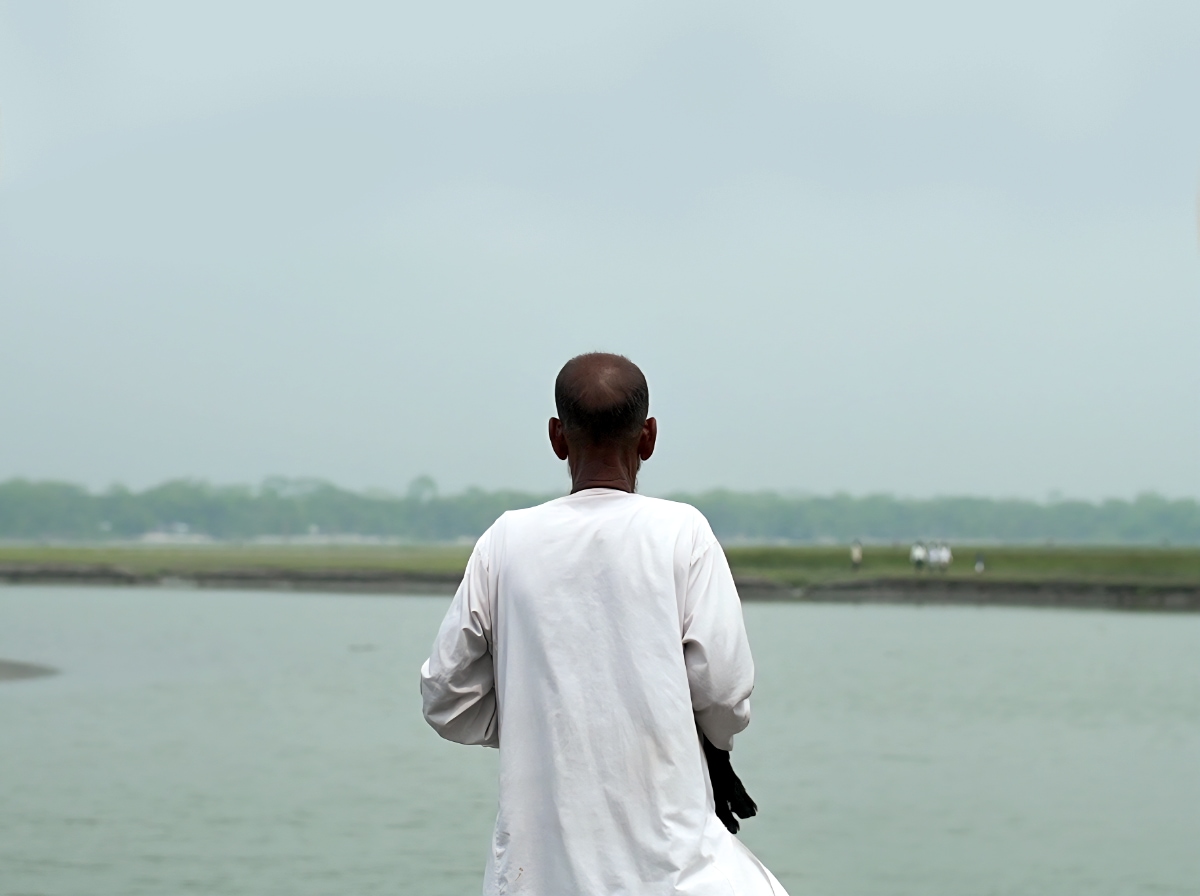
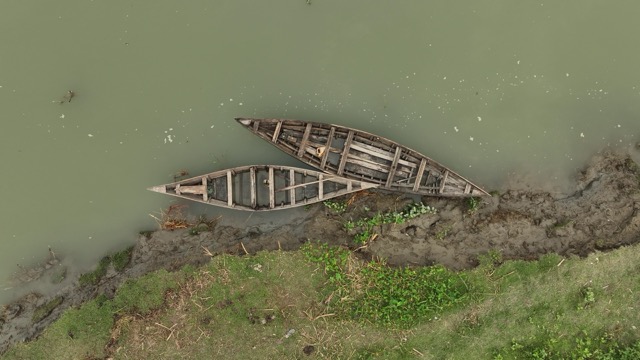
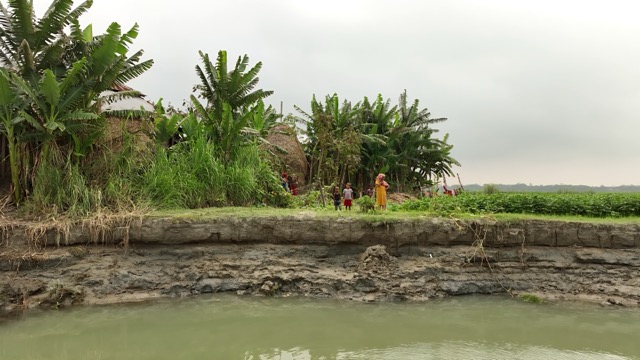
Another large piece of soil broke from the riverbank and disappeared into the Meghna. Dulu Aladar watched it go without a word. He sat on the bank, worry working across his face. The Chaitra sun, the last month of the Bengali year, hung overhead, but its heat had thinned. Dulu’s only thatched house stood fifteen feet from the water. Erosion had already eaten the distance down to almost nothing. One more strong cut and the house would be in the river too.
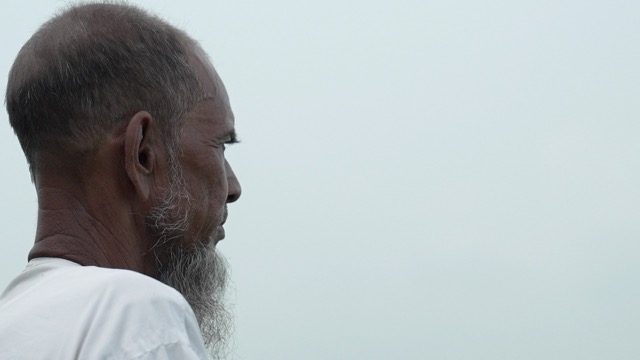
Dulu stretched out his arm and pointed about two hundred meters into the middle of the Meghna. “Four years ago, I had my own house there,” he said. “A cowshed, a courtyard, a graveyard. Now there is nothing. The Meghna swallowed everything. Now there is only endless water. Cargo ships pass over the place where I lived.” I looked from the river back to his eyes. I saw nothing in them but emptiness.
Dulu lives in Hijla Upazila of Barisal district, in southeastern Bangladesh. In Dakshin Baushya, a village of Barajalia union, he once held land, a house, and rice fields. Now he holds river water.
“Every morning, people wake and think about food,” Dulu said. “We wake and think about how close the water is to the wall. Every night before sleep, I pray the river does not take the house while we are inside. If it takes the house in daylight, at least we can run. At night we cannot.” He sighed.
Hope of a normal life does not live in this part of the global south. The struggle here for survival is too plain to fit inside words.
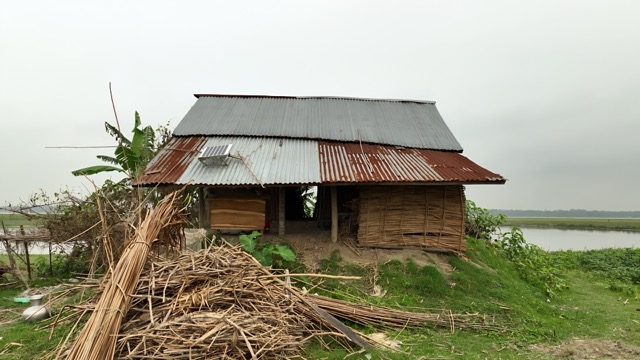
Dulu’s straw house
“Seven of us live in this house,” Dulu told me, sitting on the open veranda in front. “My wife, my younger son Siddiq, my other son Rubel, his wife, and their two children.” The walls are rice straw. The roof is old corrugated iron. There is no government electricity in this stretch of riverbank. A small solar panel was the only source of light, and it has been broken for several days. The house has one bedroom. The veranda doubles as a kitchen on its other half.
How do seven of you live in one room? I asked. “I hang a sheet across the middle like a curtain,” he said. “On one side, my wife and younger son sleep. On the other side, Rubel sleeps with his wife and the two children.” For families like Dulu’s on the riverbank, this kind of arrangement is daily life. The house holds no furniture, only two large blue plastic oil drums. One holds a few clothes. The other holds cooking utensils, pots, pans. In the eastern corner sit a broken chowki (small wooden bed) and two oily pillows.
The drums are not for storage alone. “When the bank breaks and the house sinks into the river, these drums float,” Dulu said, showing them to me. “What is inside sinks, but the drums themselves rise. I can grab them and carry them to higher ground. Even if the house and the land go under, I can save something.” He told this story of saving lives without any heat in his voice.
Livelihood and economic hardship
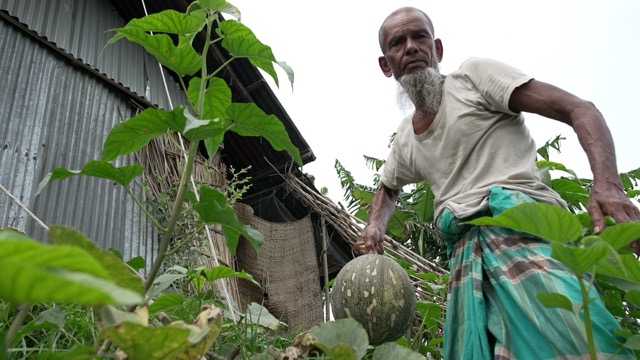
Extreme poverty has never lifted from Dulu’s family. “I have never had rice, fish, vegetables, and pulses on the same plate,” he said. “We live by the river so we sometimes catch fish. The thing we lack most is rice.” We walked together on the strip of land in front of his house. Dulu has farmed all his life. The river has taken the rice fields. What remains is sandy soil, fit only for pulses. To eat rice, the family has to buy it. With seven mouths, the math does not work.
Dulu Aladar is sixty-five now. His body no longer holds the strength for the field. His younger son Siddiq, sixteen, did not go to school for lack of money and now works in a betel garden. The other son, Rubel, takes daily labor where he can find it. “Whatever we earn goes to rice,” Dulu said. “What is left for medicine, for school, for the house?” He asked the question and did not answer it.
Childhood and youth
Dulu spent his childhood and youth on the banks of the Meghna. The river that gave him much also took back many times more. His parents were poor, and he could not study or play. As a small boy he worked as a helper on a fishing boat. The river then was kinder. “When I was a child, I did not fear the river would take everything,” he said. “Now erosion, floods, and tidal surges keep growing year by year. They have taken everything from us.”
Marriage, family, children
In his youth, Dulu farmed rather than fished, even though the river was at hand. After marriage, his wife bore three sons and four daughters in turn. Pressed by money and custom, Dulu married off all four daughters as children. “So many daughters. As a father, it was my responsibility to marry them all. When someone asked, I gave them. How long could I feed so many faces?” He looked at me. I did not answer. For two of the weddings, he had to pay the groom’s family a dowry. He raised the dowry by borrowing from a moneylender at high interest. The thought of the loan made him fall silent.
The children’s lives
Dulu and I sat in front of the house. His wife was roasting dried chilies. The smell reached us. Lunch today would be simple: dried chili vorta (a paste of mashed chilies and salt), rice, and dal. None of his seven children had been able to study properly. Each one had to leave school early to keep the family going. Four did not finish primary. The four daughters married young and went to their in-laws’ houses. The eldest son, Hasan, lives with his wife in the Kalyanpur slum in Dhaka. He has three sons and two daughters. He cleans for very low wages. The middle son, Rubel, and the younger son, Siddiq, live here with their father. None of them can spare much for him. “They cannot feed themselves properly,” Dulu said. “How will they feed me? Let them live well with their families. I have no demands. How long do I have to live?”
Tax on water
Dulu offered me a piece of information that shook me. “We were five brothers and two sisters,” he said. “My father left us one kani, about four-tenths of an acre. My share came to two and a half kathas, around eighteen hundred square feet. All of it has gone into the Meghna. The water there is deep enough now for ships. And every year I still walk to the government land office and pay the land tax on it.”
I asked why. The land does not exist. “If I do not pay,” he said, “it becomes government khas land. I lose any claim.” But what does that change, I said. The land is gone. The river is not anyone’s private property. Dulu answered, “If a char, a sandbar, ever rises again at this stretch of the river, my receipt will let me legally take back two and a half kathas there.”
Do you think a char will rise in your lifetime? “No,” he said. “But if one rises one day, my children or their children can go and claim the family’s specific piece of land at that time.” He said it with a small sigh.
Waiting for the fifth break
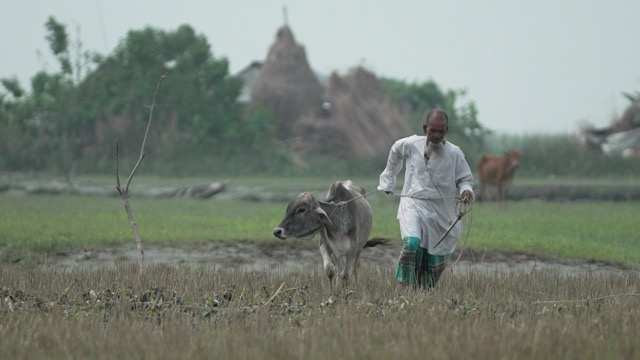
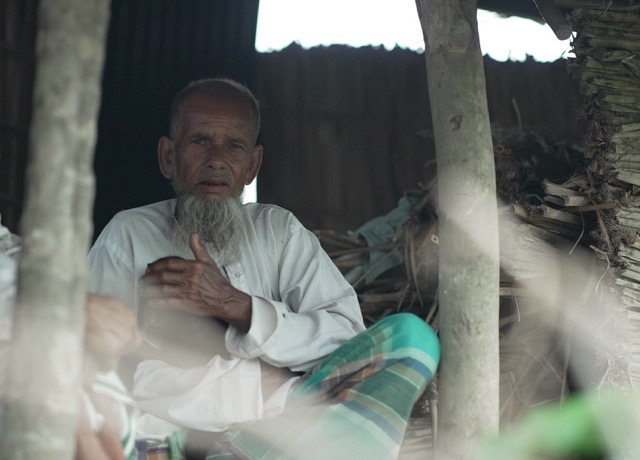
The afternoon went. The sun had already moved low in the west. Its light had thinned further. Fishermen of the Meghna had begun to return in their small boats. Their day’s catch was over. Some would sell to the market, some to a household. Dulu set out to bring his cow back from the field. I went with him. Malnutrition has thinned his body. Long walking comes hard. The grazing field lies far. If this house collapses, I asked, where will you go? He did not look at me. He looked at the road. “My house has collapsed four times,” he said as he walked. “Every time I have run west. If it goes this time, there is no more room to stay here. This time I will have to leave the area.” Where will you go? I asked. He did not answer. After a silence he said, “I do not know.”
The first need is to stay alive
Dulu does not know where he will go if the river takes the house again. Even at his age, life carries no promise. He lives every day in the fear of losing his roof. “People think about food, about treatment, about education. We think first about saving our lives,” he said. “Every night I think about whether I will be alive in the morning. Whether the house will be.” He drew a long breath. “We have not a single penny saved. We do not know if there will be a meal tomorrow. We have no money for medicine, no money for school. To think about those things is a luxury for us. We only think that the river will not take our lives, that the river will not drown our land.”
I asked whether the village had ever received help. “What help? We have not received any,” Dulu said at once. “Not for a house, not for food, not for treatment, not for land. None of it.” Have you received help from any private organization? I asked. “No,” he said. “No NGO has ever helped us.”
What about the days ahead, I asked. How will you live, where will you go, what will you do, how will you earn? He did not answer the question directly. He said, “If I die, they will have to drown me in the water. There is no place left for a grave.” Tears were falling silently from his eyes. His voice was heavy. The orange light of the western sun was on his cheeks and on the tears. His sad face caught the orange. Seeing him cry, his pet goat climbed restless into his lap. He patted the goat’s head. Time passed. Evening came down on the Meghna. The water was calm. In my mind it was time to begin the road back to Dhaka.
Why no help has reached him
Bangladesh’s main national fund for climate work is the Bangladesh Climate Change Trust (BCCT), set up in 2009 and 2010. Some money also comes from international sources, including the Green Climate Fund and the Bangladesh Climate Change Resilience Fund. Government estimates put the country’s annual climate adaptation needs at about $12.5 billion, around 150,000 crore taka. Yet between 2015 and 2023 the climate share of the national budget averaged only 0.7 percent, around $86 million per year.
Through the BCCT, $458.5 million was allocated to 891 projects between 2010 and 2024. Of that, 54 percent, about $248 million, was lost to corruption, misuse, and irregularities. Transparency International Bangladesh (TIB) laid out these figures in its November 2025 report.
Where the money goes
The TIB report describes corruption at three stages of the project cycle. The first is bribery during project approval. Projects pass under the influence of ministers, the board chairman who is the minister of the environment, and political leaders. One board chairman, who served from 2010 to 2013, allocated 1473 percent more money than the average to projects in his own constituency. Proposals were submitted at the last minute and approval was settled in advance.
The second stage is the appointment of contractors. Tenders are rigged through contractors aligned with the ruling party. In the solar streetlight programme, 216 of 373 projects between 2019 and 2023 listed equipment prices 47 to 57 percent above the going rate. The loss came to between $17 million and $20.7 million.
The third stage is implementation. Some are “signboard projects,” where state money is drawn down by simply putting up a board. In other cases the work is poor or unfinished. A solar panel might fail in a year while paperwork claims a five-year warranty. As a result, 61.6 percent of projects are delayed, and some by more than two thousand days. Monitoring is thin. Outside audits are almost absent.
Why the Meghna’s erosion victims are missed
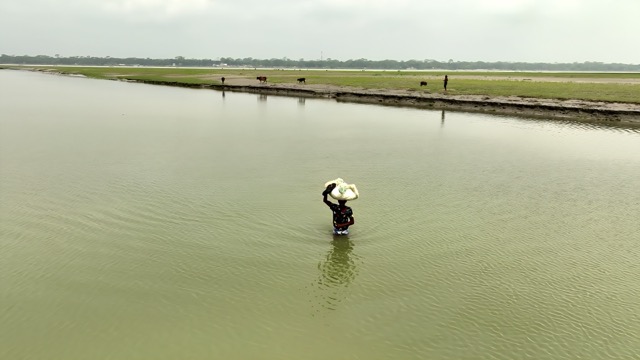
A deeper look raises further problems. Project allocations do not match the actual climate risk. The Spearman correlation between risk and money sent is only 0.2. Districts at high risk, such as Barisal, Bhola, and Patuakhali, receive less. Districts at lower risk receive more. Visible projects, like solar streetlights and eco-parks, attract money. Slow-onset problems, like river erosion, do not. In the Hijla and Meghna stretch, erosion takes 8,700 hectares of land each year and affects more than 200,000 people. Targeted projects for this area are very few.
Marginal communities are largely shut out of project design. Riverbank poor and landless families like Dulu’s have no place at the planning table. No policy carves out a separate target for the “ultra-poor” or for “river erosion victims.” Shelter projects and cash assistance exist on paper, but bureaucracy, political pull, and corruption keep them from reaching the people who need them. Decisions made in Dhaka rarely move into the field, and monitoring on the ground is missing as well. Shelter and rehabilitation projects for erosion victims do exist, but many people like Dulu have never received anything from them, because lists are drawn up irregularly and political preference shapes who appears on them.
This is more than wasted money, TIB writes. It is a betrayal of the people most exposed to the climate.
What could be done
TIB and other groups recommend several changes. The BCCT Act needs amendment to bring in an independent board, clauses against corruption, and stronger transparency. Project selection should be weighted to actual risk on the ground. Local communities should take part in monitoring, with grievance mechanisms at the field level. Cash and housing assistance should go directly to the marginal, as grants rather than microfinance. Corruption cases should be investigated by the Anti-Corruption Commission free of political interference, and the guilty punished as a matter of example.
Climate experts argue that the funds exist. Governance failure, corruption, and political interest keep them from reaching the people who need them. Millions like Dulu Aladar are the result. This is not only a climate problem. It is a governance problem. Without transparency and accountability, they say, the cycle will continue.