





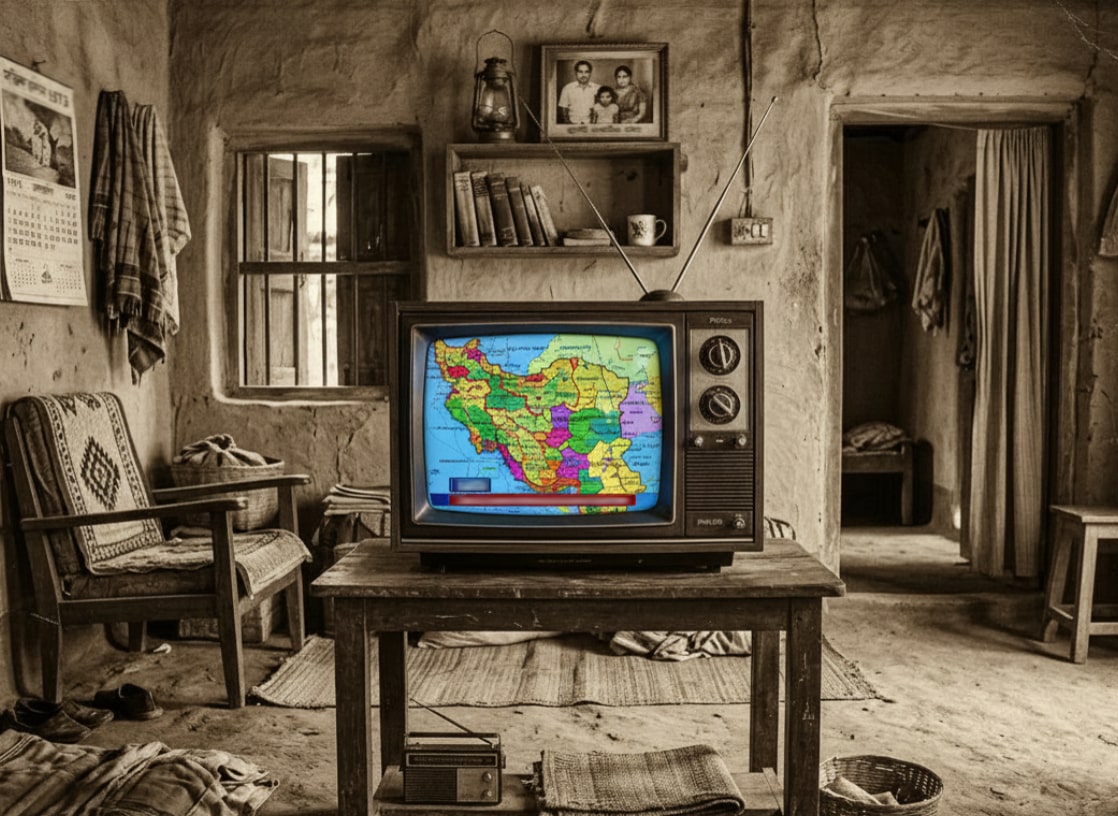
Imagine a woman in a village outside Feni. Call her what you like. She is waiting for the monthly message from her son in Sharjah, the one that carries the taka that keeps her household fed, her grandchildren in school, the tin roof from leaking. She cannot read English. She does not subscribe to Jugantor or Samakal, but one of them passes through her son-in-law’s hands at the tea stall, and the headlines reach her in fragments. In April she hears that a civilization may be destroyed in a single night. She does not know which civilization. She knows only that her son’s flight home, if it ever comes, will cross the sky above it.
She is a composite, not a source. But the village is real, the son is real, and some version of her lives in every union parishad in this country.
This is the test her newspapers are failing. The Iran War, in whatever form it next assumes, is not a distant story for Bangladesh. It is an economic earthquake waiting for its trigger. Sixty percent of the country’s crude oil crosses the Strait of Hormuz. Liquefied gas from Qatar and Oman lights roughly a fifth of the grid. Close to half of the $32.8 billion Bangladeshi workers send home each year originates in Saudi Arabia, the UAE, Qatar, and Oman. The Gulf is not elsewhere. The Gulf is her rice field, her grandson’s exercise book, her neighbor’s new sewing machine.
And yet, to read the opinion pages of Bangladesh’s four largest dailies through the sharpest weeks of the conflict is to encounter four different countries. The Daily Star writes for a Bangladesh that lives on the edge of the war’s economic blast radius. Prothom Alo writes for a Bangladesh that has strong feelings about Tehran’s sovereignty. Jugantor and Samakal write for a Bangladesh that could be anywhere in the world, because the anywhere of the world is what their wire copy describes. The woman in Feni lives in only one of these four countries. In the other three, she is an abstraction or she does not appear at all.
The Daily Star: the war as household arithmetic
The Daily Star is doing the one thing Bangladesh’s press most needs to do. It translates the war into taka and rice and kilowatt-hours. Its opinion section reads like a ledger of exposure. “War fallout to slow growth, deepen poverty: WB.” “Bangladesh economy caught in the crossfire.” “The Iran war is exposing Bangladesh’s economic vulnerabilities.” The headlines repeat themselves because the point will not stop being true.
The contributors include an associate professor at IUBAT writing about rice fields, a senior manager at BRAC writing about empty wallets in village homes, and an opposition MP writing about when distant wars hit home. The register is plain. The numbers are specific. Refayet Ullah Mirdha’s reporting on protracted war and Bangladesh’s current account deficit sits next to Tasnuba Sinha’s piece on a Gulf war and a village without its breadwinner. The two halves belong to the same story.
Security analysis appears too, and it asks larger questions. Will this war create a new world order? Does gangster imperialism threaten global peace? These are fair subjects. But the paper anchors them to Chattogram port and Bhola’s gas fields before it lets them float. The editorial instinct, visible across weeks of coverage, is to pull the global back down to the local. It is the right instinct. It is also, among the four papers surveyed, close to unique.
Prothom Alo: sympathy for Tehran, and some attention to the worker
Prothom Alo, the country’s largest Bengali daily, brings something the English paper does not, which is sustained ideological temperature. Its op-ed section leans toward Iran. Translations from Al Jazeera and Middle East Monitor frame the conflict as a civilizational provocation by the United States and its allies, with Iran’s sovereignty treated as a principle worth defending. One translated headline reads “How the Iran War Could End” and casts territorial integrity as the path to peace. Another calls the war an American crusade dressed in apocalyptic language.
This is a real editorial stance, and Prothom Alo is entitled to it. The paper’s readers want more than neutrality. They want to know whose side their newspaper is on, and the paper answers them.
Where Prothom Alo does better than its Bengali peers is in keeping the Bangladeshi worker on the page. মধ্যপ্রাচ্যে আমাদের শ্রমবাজারের ভবিষ্যৎ কী (What Is the Future of Our Labor Market in the Middle East?) asks the question that should be impossible to avoid in a country where the Gulf accounts for the majority of overseas jobs. The piece does not answer it the way The Daily Star would, with current account figures and migration strategy, but it asks, and the asking matters. The woman in Feni gets a few inches of column space.
The rest is world commentary, much of it translated. Dubai’s hidden costs. Trump as a bungling Churchill. The reshaping of the global order. These are good op-eds for a reader who treats the newspaper as a window onto the world. They are less useful for a reader who treats the newspaper as a mirror held up to her own life.
Jugantor and Samakal: the view from a great-power summit
Jugantor leans on BBC, CNN, Time, and The Guardian. Its opinion pages could run in any country with a middle class interested in foreign affairs. Does Iran prefer a long war to a ceasefire? What does each side want? Why has American military power failed to close the conflict? These are legitimate questions, handled capably by writers in London and Washington and translated with care by Jugantor’s staff.
What is missing is Bangladesh. Across the Jugantor op-eds surveyed, no essay asks what the conflict means for a garment worker in Narayanganj whose brother sends money from Doha, or for a farmer in Rangpur whose diesel costs will follow the price of Brent crude. Retired Brigadier General Bayezid Sarwar contributes memoir from his own Middle East postings, and the veteran commentator Anwar Hossain Manju writes on Israeli diplomacy. The frame is great-power rivalry and regional alignment, viewed from thirty thousand feet. The view is handsome. It is also not where most of Jugantor’s readers live.
Samakal operates on the same model with a slightly wider sourcing net: The Guardian, Asia Times, Reuters, Al Jazeera. Damiana Bakardzhieva on the Hormuz blockade. Manzur Rashid on the erosion of humanitarian values in wars of hegemony. Badrul Hasan on peacekeeping diplomacy. Good writing, much of it. And, in one welcome exception, a piece by the banker Saiful Islam titled হরমুজ থেকে ঢাকায় ছড়িয়ে পড়া বৈশ্বিক সংকটের অর্থনীতি (The Economics of a Global Crisis Spreading from Hormuz to Dhaka). That headline is the piece the Bengali press should be running every week. At Samakal it runs once.
Five headlines, one threat
The clearest proof of how each paper reads the war sits in a single story. President Trump threatens to take out Iran “in one night” if Tehran does not reopen the Strait of Hormuz. The BBC runs a plain wire lede. Five Bangladeshi front pages translate it.
The Daily Star keeps the spine: “US can ‘take out’ entire Iran in a day.” It is a headline a policy reader can do something with.
Prothom Alo adds Tehran’s posture: এক রাতেই ইরানকে নিশ্চিহ্ন করার হুমকি ট্রাম্পের, অনড় তেহরান. Trump threatens obliteration; Tehran does not flinch. The sympathy is visible in the syntax.
Ittefaq raises the stakes to theology: আজ রাতে একটি সভ্যতা সম্পূর্ণ ধ্বংস হয়ে যাবে. A civilization will be destroyed tonight. The headline does not quote Trump. It pronounces the event.
Jugantor and Samakal stay closer to BBC phrasing, varying the attribution and the verb. Their readers get the wire, cleanly, with the source named.
Five translations of one threat. One version connects Bangladesh to the danger. One chooses a side. One reaches for apocalypse. Two hold up the wire copy like a document to be read rather than interpreted. None of them tells the woman in Feni, in her own language, what she needs to know, which is that the flight home her son is saving for may cost twice as much by September and that the company he works for may lay off Bangladeshi contract labor first.
The structural honesty Bangladesh’s press owes its readers
The wire dependency is real and it is not, on its own, a scandal. No Bangladeshi paper has a correspondent in Tehran or Tel Aviv. The costs of stationing one, in money and in risk, are not trivial. For now, translation is what the editors can afford. The question is what they translate and how they frame it once they do.
Framing is an editorial choice, not a logistical constraint. A paper that runs three wire pieces on great-power maneuvering can also run one local piece on what this means for a family in Feni. That sort of piece requires a phone call to a labor recruiter, a visit to a hundi trader, an hour with a Bangladesh Bank economist. It is cheap journalism. It is also the journalism that connects the reader to the story. The Daily Star shows the connection can be made consistently in English. The Bengali papers have the larger readership and the greater obligation. They are mostly declining the assignment.
A press that speaks past its readers is not serving them, whatever its editorial sympathies. Sympathy for Tehran is a defensible position. So is alarm at American overreach, suspicion of Israeli policy, and concern for the collapse of the UN system. These are adult arguments, and Bangladeshi readers are adults. But they are also, most of them, adults whose household budget is one oil shock away from contraction, whose relatives are one evacuation notice away from joblessness, whose winter gas supply depends on ships that pass through a strait two Iranian missiles could close.
Back to the village
The woman in Feni does not know the name Bakardzhieva. She cannot pronounce Maududi. She has never heard of the Jamaat’s founder or Churchill’s Iran policy. She knows that her son’s company has paused new contracts for three weeks, that the price of edible oil is rising again, that her neighbor’s husband came back from Qatar without the savings he was supposed to bring, and that the newspapers someone reads aloud to her at the tea stall are full of words she does not recognize.
She is a composite. The pressures on her are not. Every union in this country has families whose monthly budget hinges on a remittance from the Gulf, and every one of those families is a reader, direct or once removed, of the Bangladeshi press.
The test of a newspaper is not whether it tells the world’s story correctly. It is whether it tells its readers their own story well enough that they can act on it. On the Iran War, The Daily Star is doing that work for its English-reading audience. The Bengali press is treating its own readers as spectators at a global match, when in truth those readers are players on the field.
A war is unfolding in the Gulf, and a village in Feni is waiting for news. Bangladesh’s largest newspapers should be in a hurry to reach it.