



Television in Bangladesh in the early nineties had a strange authority. There was one channel. No competition. When something unusual appeared on BTV, it tended to linger in the imagination longer than it might have in a more saturated media environment.
I was eight or nine years old, maybe 1993 or 1994, and BTV had scheduled something outside the usual movie-of-the-week slot. Some cultural occasion I can no longer name, something that timed with an Iranian event. What I remember is the film itself. An elderly person and a boy traveled through a region wrecked by an earthquake. They wandered through rubble where sad, broken people sat with blank, haunted looks, having lost family and everything they owned.
There was silence. Still, photograph-like scenes. Sad music that settled into a melancholic image in my mind. I did not understand much of the film and could not recall its name. But the images stayed the way certain childhood scenes do, without explanation. Rubble. Quiet roads. Grayish blue skies. People standing amid ruins with a look of exhausted stillness. Even at that age, I sensed the difference between this film and the ones that usually appeared on television. There were no villains. No sudden bursts of action. The camera seemed content to watch.
Much later, when I developed a taste for world cinema, I learned it was Abbas Kiarostami’s 1992 film Life and Nothing More. By then Kiarostami occupied a special space in my mind and had ignited a thirst for the kind of cinema that made people pause and think.
I owe my cousin for pushing me through the door. It was 2003, and my movie taste was shaped almost entirely by Hollywood. My post-teenage mind had a predilection for American college comedies. I was never a big fan of action, except for some 90s cult favorites: The Rock, Con Air, Broken Arrow, Face/Off. Those were the golden years of Hollywood action.
Many teenagers in that era followed similar paths. Hollywood provided the language of entertainment: the rhythm of jokes, the dependable arc of conflict and resolution. The action films of the nineties possessed a certain flamboyant charm. Sean Connery stalking through Alcatraz. Nicolas Cage racing through chaos. The surreal face-swapping spectacle of John Travolta and Cage squaring off. Excessive and fun.
So to a mind shaped by those films, Kiarostami had no chance of entry unless someone pushed.
My cousin Yusuf Banna, a poet my own age, had developed a far more mature taste for cinema by then. I did not know how, exactly, but he ran with the Little Mags crowd at Aziz Super Market in Dhaka. Aziz Super Market was, and in many ways still is, one of those curious urban enclaves where literary and artistic subcultures gather. Small magazines circulated among poets, students, writers, and critics. Conversations about literature and cinema flowed with the same casual intensity as tea. It was the sort of place where one might stumble upon filmmakers whose names never appeared on mainstream screens.
Banna once took me to the Russian Cultural Center for a screening of a film by the master Japanese director Yasujiro Ozu. I sat through 20 or 25 minutes and felt so sleepy that I stormed out, took a rickshaw to Banna’s house on the opposite side of Dhanmondi Lake, went upstairs, and fell asleep in his bed. I told him later that Ozu’s films had a gift for putting people into a deep sleep.
At the time, the remark felt reasonable. Ozu’s deliberate pacing seemed less like contemplation and more like sedation. The still camera and the lack of dramatic urgency did not align with the cinematic language I had grown accustomed to.
On another occasion Banna brought me to a screening of some lesser known Polish director at Aziz Super Market. I felt bored. The famous Bangladeshi actor Gazi Rakayet sat beside me, visibly annoyed that I kept trying to strike up a conversation with Banna during the film.
The etiquette of art house cinema was still foreign territory for me. Then The Wind Will Carry Us happened.
One rainy afternoon, Banna, a friend of ours, and I were having adda at Banna’s place in Dhanmondi. He told me he would show me a film that would change my mind about “artsy cinema,” which is what I used to call it, half joking. He put on a DVD of The Wind Will Carry Us.
The first few minutes hooked me. A rugged, hilly terrain in the Iranian hinterland. A somewhat annoyed, middle-aged engineer wandering through a village, talking with local people, sipping tea in a beautiful hillside tea shop where elderly men and women discussed the stranger from the city.
Nothing dramatic happened. Yet something about the rhythm of the film, its patience, its attention to ordinary gestures, began to pull me in. The landscape. The people. The conversation. Without realizing it, I started to appreciate the long shot, the pause, the space, the photogenic framing that Kiarostami used to build his world.
From then on, there was no turning back.
For those who discover it late, Iranian cinema often feels less like a film industry and more like a quiet arrival. It does not announce itself with spectacle. It enters gently.
That gentleness is tied to Iran’s cultural inheritance. The country’s artistic traditions stretch back through Persian poetry and storytelling rooted in the golden age of the Persian Empire. Cinema, when it arrived in the late twentieth century, inherited that sensibility: a patient eye for detail, a reverence for landscape, a philosophical curiosity about the human condition.
The rise of Iranian cinema as a global force from the late 1980s onward remains one of the most striking stories in modern film. Directors like Kiarostami, Mohsen Makhmalbaf, Jafar Panahi, and Majid Majidi forged a cinematic language that was local in its textures but universal in its concerns. Their films relied on non-professional actors, natural landscapes, spare storytelling, and narratives rooted in everyday life. Beneath that simplicity lay serious questions about morality, identity, childhood, and resilience.
What surprised many international critics was that such a movement could emerge from a country with strict censorship and limited production resources. But the restrictions became part of the creative engine. Iranian filmmakers learned to speak through metaphor, allegory, and visual suggestion to explore social realities they could not address head on.
Kiarostami mastered this balance between simplicity and depth. His films often appear straightforward. A child searching for a notebook (Where Is the Friend’s House?). A man driving through the countryside, contemplating life (Taste of Cherry). A visitor waiting in a remote village (The Wind Will Carry Us). Yet these stories carry a philosophical weight that stays with a viewer long after the screen goes dark.
The Wind Will Carry Us, the film that changed my own sense of what cinema could do, follows a man who arrives in a remote Kurdish village to wait for an elderly woman’s death so he can document traditional mourning rituals. Yet the film rarely shows the event he is waiting for. Instead, it lingers on daily life. Tea shops, dusty roads, conversations with villagers, the quiet rhythm of rural existence. In Kiarostami’s world, the most important moments often occur off screen.
That approach reflects a broader tradition in Iranian storytelling, one that values suggestion over declaration. Persian literature, from Rumi and Hafez to modern Iranian prose, has long embraced ambiguity and layered meaning. Iranian filmmakers inherited that tradition and transformed it into visual language. A long shot of a winding road across hills becomes a metaphor for a journey through life. A child’s question carries philosophical weight. Silence becomes dialogue.
For viewers raised on faster commercial cinema, the adjustment can be difficult. I remember the initial resistance. The stillness felt unfamiliar. The pacing seemed slow. The narratives appeared minimal. But once the rhythm settles into the mind, the experience changes you. You begin to notice things you once overlooked: the way light moves across a hillside, the pauses between conversations, the humanity embedded in everyday gestures. Iranian cinema teaches the viewer how to watch again. And once you learn that way of watching, it becomes hard to go back.
International audiences began recognizing this power in the 1990s. Films from Iran started winning major prizes at Cannes, Venice, Busan, and Berlin. Critics praised the movement for its humanism, its realism, and its ability to cross political borders.
As the scholar Hamid Dabashi has observed, Iranian cinema became global because it embraced its own cultural identity. By telling local stories about villages, families, children, and moral dilemmas, it reached universal emotions.
A child searching for a friend’s house in a small Iranian village felt relatable to viewers on the other side of the world. Through cinema, many viewers discovered a side of Iran rarely shown in political headlines: a society rich in literature, philosophy, humor, and artistic creativity.
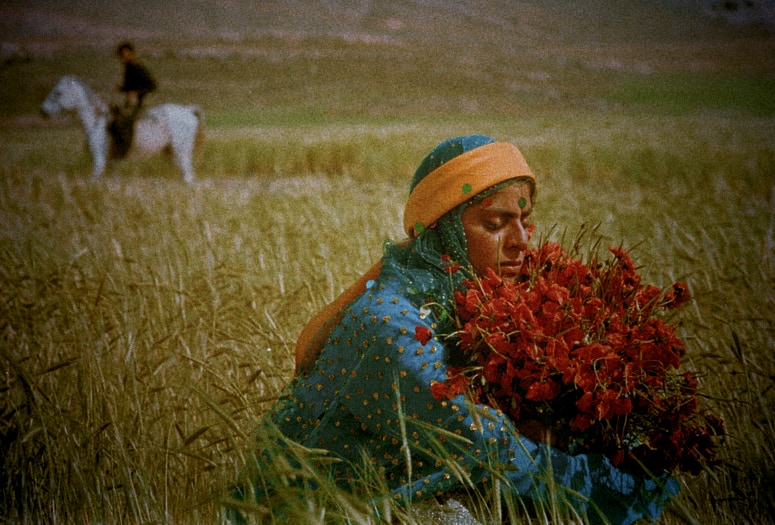
In Makhmalbaf’s Gabbeh, the Iranian landscape itself becomes part of the narrative. Set among nomadic tribes, the film opens with an elderly couple washing a colorful carpet by a river. From the patterns of the carpet emerges the story of a young woman in love. The camera lingers on rolling hills, migrating tribes, and bright textiles fluttering in the wind, turning everyday life into something lyrical. A simple love story becomes a meditation on memory, folklore, nostalgia, and the bond between people and land.
Jafar Panahi, by contrast, finds depth within the ordinary rhythms of urban life. In The White Balloon, a little girl searching for money she dropped through a street grate wanders through crowded Tehran, encountering shopkeepers and strangers who briefly become part of her story. The plot is simple, yet through these encounters Panahi reveals the fragile kindness that holds everyday life together. In Taxi, conversations between passengers inside a cab unfold into reflections on law, morality, love, and freedom.
This emphasis on observation is what struck me when I first watched The Wind Will Carry Us. The film seemed to slow time itself. The camera lingered on hillsides and faces, and the silence felt meaningful. Somewhere during those quiet conversations at the village tea shop, something shifted in my understanding of cinema.
Movies, I realized, did not have to rush toward climax or spectacle. They could simply exist.