



Before I ever visited Paris, I knew Guillaume Apollinaire’s name only faintly. It appeared in translations, a distant presence in the literature of European modernism. One afternoon, browsing without much purpose, I discovered his poem Le Pont Mirabeau. The idea puzzled me. Why would a poet devote an entire poem to a bridge?
Later, after arriving in France, curiosity led me to the bridge itself.
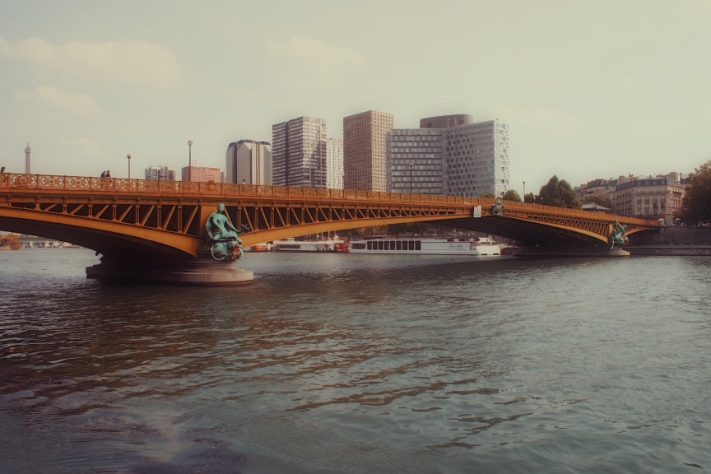
The revelation was spatial, not visual.
The bridge could be stood upon. Small recesses along the parapet allowed pedestrians to lean without obstructing others. Suspended above the slow current of the Seine, one could remain there indefinitely, watching the water pass beneath the arches.
Standing there, the poem clarified itself. The bridge was not the subject at all. What the poem assumed was something more basic: that a person could remain in one place long enough to watch time pass beneath him.
Cities teach bodies these possibilities. From such small permissions, where one may linger and how long one may remain, entire forms of thought emerge.
Nineteenth-century Paris gave a name to the figure who inhabits such spaces: the flâneur.
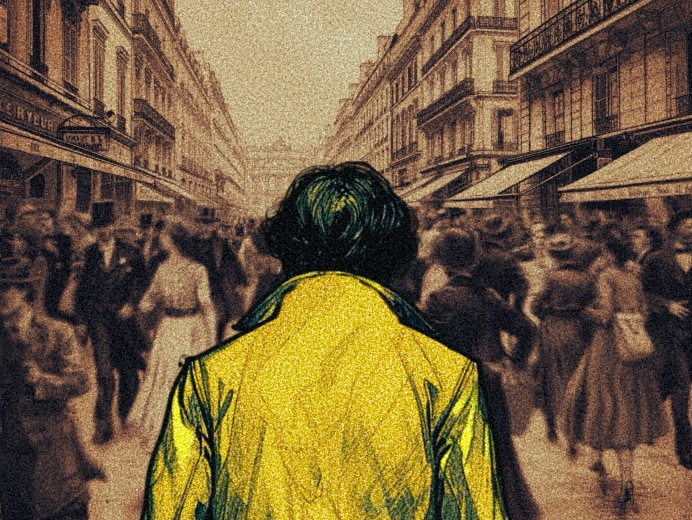
First sketched by Baudelaire and later theorised by Walter Benjamin, the flâneur is a wanderer of the modern city. He walks through crowds without urgent destination. He observes without belonging. The city becomes legible through his drifting movement.
But the flâneur is also a spatial product.
Paris produced him because Paris produced the conditions in which he could exist. Haussmann’s boulevards permitted strolling rather than squeezing through traffic. The arcades created sheltered corridors for idle observation. Bridges across the Seine offered vantage points where a person could pause above the river without interrupting pedestrian flow.
These spaces permitted something radical: useless presence. A person could remain in public space without explanation. The flâneur exists because the city tolerates him.
Dhaka offers a different lesson
Like Paris, Dhaka is a city of rivers. The Buriganga and the Turag once shaped its commercial life much as the Seine shaped Paris. Bridges now cross these waters in growing numbers. Yet the experience of standing upon them reveals a sharp difference.
A pedestrian stepping onto one of Dhaka’s bridges discovers that lingering is difficult. Pavements narrow between roaring lanes of traffic. Buses thunder past with impatient horns. Motorcycles weave through any remaining space. The pedestrian becomes a temporary obstacle within a system designed for movement.
One crosses the bridge and keeps moving.
To pause is to disrupt the rhythm of engines. The bridge is a corridor, not a balcony above the river.
This small architectural difference shapes the kinds of urban subjects cities produce. The flâneur requires pockets of tolerated stillness within the machinery of movement. Without such spaces, wandering becomes difficult. Dhaka’s tempo rarely encourages stillness. Its modern history has been shaped by urgency: migration, density, political upheaval, economic pressure. Movement is seldom leisurely. One walks because one must reach somewhere else.
In such a city, the purposeless wanderer appears improbable.
And yet Bengali literature possesses one
Created by Humayun Ahmed, Himu enters literature in a simple but unforgettable form: a young man wearing a yellow panjabi without pockets, walking barefoot through Dhaka’s streets. The absence of pockets is deliberate. Pockets imply money, work, responsibility. Himu carries none of these.
He walks.
Across the twenty-one Himu novels, he drifts through tea stalls, hospital corridors, railway stations, and residential streets long after midnight. Sometimes he appears at the house of Majeda Khala, where he eats before disappearing again into the city. Sometimes he meets Rupa, the woman who loves him with a patience that borders on tragedy. Rupa represents the possibility of ordinary life: marriage, stability, belonging. Himu never enters that world. He approaches it but remains outside.
He might stand beneath her window speaking about strange philosophical matters. Then he disappears for weeks, wandering through the city, and returns as if nothing had happened. This pattern repeats throughout the stories. Himu approaches life but never settles inside it.
At night, the city loosens its grip on urgency
In many stories, Himu walks through Dhaka long after midnight. Streetlights flicker above empty intersections. Tea stalls remain half open. A few stray dogs follow him from one neighbourhood to another. The traffic that dominates the day has thinned into occasional distant engines. He walks through these hours as if the city belonged to him alone, stopping to speak to strangers who are never sure whether they have encountered a mystic, a madman, or something in between. In those moments, the city becomes visible because someone is looking at it without hurry.
At first glance, Himu resembles the flâneur. Both figures wander through the city observing people and places. Both appear detached from ordinary work and obligation.
But the resemblance is deceptive.
The Parisian flâneur is socially permitted. In Paris, the wandering observer dissolves into the crowd. His purposelessness attracts little attention. In Dhaka, purposelessness becomes spectacle. A barefoot man wearing a bright yellow panjabi and speaking in riddles to strangers becomes an object of fascination. Some characters believe he possesses supernatural powers. Others dismiss him as eccentric. Humayun Ahmed sustains this ambiguity with care. Himu never claims supernatural insight, yet coincidences accumulate around him. Predictions come true. Problems resolve themselves after he appears. The mystery remains unresolved. But one fact is clear: Himu commands attention.
The ragpicker’s shadow
From a theoretical angle, Himu resembles another figure from Benjamin’s reflections on Paris: the ragpicker.
In Benjamin’s writing on the nineteenth-century city, the ragpicker is a marginal figure who wanders at night collecting discarded objects from the streets. Unlike the flâneur, who observes from a position of leisure, the ragpicker moves through the city’s forgotten edges. He gathers fragments, remnants, debris. He lives inside the city’s refuse.
This difference matters. The classical flâneur belongs to a confident bourgeois modernity. His wandering presupposes a city that can afford leisure and spectatorship. The ragpicker belongs to another urban reality, one marked by poverty, improvisation, and survival.
From this angle, Himu looks less like a Parisian stroller and more like Benjamin’s ragpicker. He moves through the margins of the city rather than its boulevards. His companions are stray dogs, night guards, and tea stall workers rather than elegant pedestrians. His wandering occurs in streets temporarily emptied of pressure, not in spaces designed for strolling. The ragpicker gathers fragments of the city’s material life. Himu gathers fragments of its human life: conversations, encounters, small mysteries. Where the flâneur reads the city like a book, the ragpicker sifts through its discarded pages.
A post-colonial flâneur
Himu may be better understood, then, as a post-colonial flâneur.
The classical flâneur emerged from the confident spaces of European modernity. His wandering assumed the form of a city designed for spectatorship. Dhaka emerged from a different history: colonial extraction, post-colonial expansion, relentless density, economic pressure. The city rarely produces the idle observer.
Himu performs a strange inversion. He wanders because he refuses the city’s logic, not because the city permits it. Barefoot and pocketless, detached from work and property, he moves through Dhaka as a figure who rejects the rhythm of productivity that governs it.
The flâneur of Paris reads the city. The ragpicker gathers its fragments. Himu unsettles it.
What cities permit, fiction provides
Cities shape literature in ways that often remain invisible. The bridges of Paris allowed poets to imagine time flowing beneath a stationary observer. The bridges of Dhaka rarely offer such vantage.
But imagination compensates for what space denies. In the absence of a wandering observer produced by its streets, Bengali fiction created one. Himu walks where the city itself cannot allow such walking. Paris produced its flâneur through architecture. Dhaka had to invent its wanderer through fiction.
And perhaps this is the irony of the modern city: the freedom to wander without purpose survives most securely in the pages of a book.