


On February 21, 1952, police opened fire on students marching through Dhaka. The students were not demanding independence or revolution. They wanted something simpler: the right to speak Bengali, their mother tongue, in their own country. Several died. Within weeks, their names had become sacred.
Those students were not powerful. They carried no weapons. By any conventional measure, they had failed. The government did not immediately reverse course. Yet something had shifted in the nation’s conscience. Bangladesh had discovered its first modern moral lesson: speaking truth in your own language is worth dying for.
That lesson would not last forever. No moral code does.
Every society operates on an unwritten agreement about what deserves respect. Not written in law. Not declared in speeches. But felt. The agreement shapes which names children memorize in school, which deaths spark national mourning, which sacrifices count as noble rather than foolish. In Bangladesh, that agreement has changed at least six times since 1952. Each shift left behind martyrs whose meaning transformed as the nation’s values evolved.
The question facing Bangladesh now is the same question that faced Poland after Solidarity, South Africa after apartheid, and the Philippines after Marcos: When the old moral order collapses, what rises to replace it?
When Sacrifice Was Everything
From the 1960s through the late 1970s, Bangladesh absorbed the global spirit of its age. Across the world, from Vietnam to Cuba to newly independent African nations, societies admired collective struggle over personal success, courage over comfort, equality over hierarchy. Bangladesh was no exception.
In 1969, a young man named Asad became a hero not because he won anything but because he stood unarmed before authority. His death during protests against the Ayub Khan regime made him a symbol. The message was clear: moral courage mattered more than credentials or connections.
The Liberation War of 1971 elevated this idea to its peak. Figures like Rumi, remembered through Jahanara Imam’s memoir of the war, taught the nation that suffering for the country was the highest form of love. Sacrifice became sacred. The collective memory organized itself around young people who gave everything for a cause larger than themselves.
But this moral framework contained a hidden danger. When suffering becomes sacred, questioning those who suffered becomes impossible. The martyrs of 1971 earned the nation’s eternal gratitude. They also created a political category that could be weaponized: the freedom fighter, whose sacrifice placed certain claims beyond challenge.
When Order Became Virtue
The 1970s delivered a brutal correction. Assassinations, coups, and chaos exhausted the revolutionary imagination. By 1975, the nation that had won independence through collective sacrifice was consuming its own founders.
Siraj Sikder represented one path not taken. He was not an uneducated rebel. He graduated from one of the country’s most elite engineering programs. His challenge to state power was intellectual, not merely emotional. For a brief moment, Bangladesh confronted an uncomfortable possibility: that education and ideals might matter more than obedience to authority.
The state rejected that idea decisively. Sikder was killed in custody in 1975. Colonel Abu Taher, who believed that justice could demand disobedience, was executed in 1976. Their deaths marked the end of the socialist moral imagination in Bangladesh. From that point forward, the nation slowly adopted a different value system: order over ideals, survival over sacrifice.
This shift was not unique to Bangladesh. Across the world, from Argentina to Indonesia to South Korea, societies exhausted by chaos made the same bargain. The generation that had dreamed of revolution grew tired. Stability felt precious. Silence felt sensible. The moral code adapted accordingly.
When an Ordinary Man Became Unforgettable
Then came 1990, and with it one of Bangladesh’s most instructive moral moments.
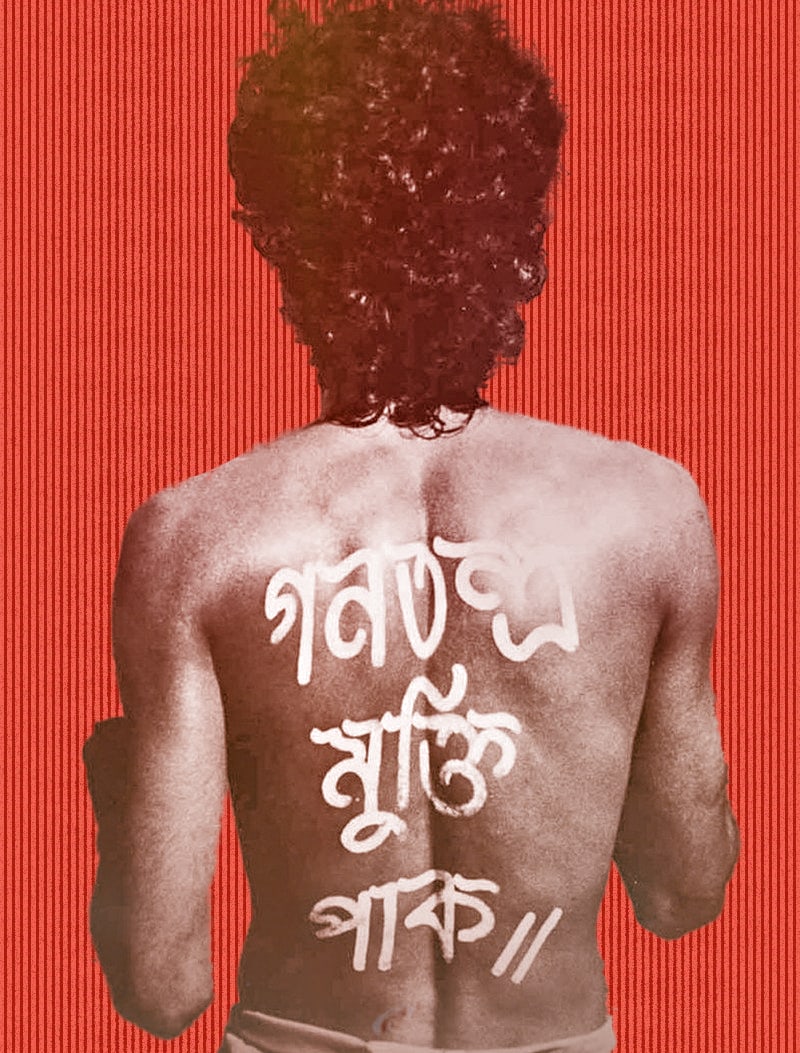
Noor Hossain was a baby taxi driver. He had no formal education to speak of. During protests against the Ershad regime, he painted slogans across his bare chest: “Let democracy be freed” and “Down with autocracy.” The spellings were imperfect. The grammar was uncertain. He marched through the streets of Dhaka, was shot, and died.
None of his limitations mattered. The nation honored him anyway.
Noor Hossain’s death revealed something important about moral codes. For a moment, Bangladesh decided that truth does not need polish. An ordinary man with misspelled slogans had spoken more clearly than any intellectual. His imperfection made him believable. His vulnerability made him powerful.
This is a pattern that appears across cultures in moments of democratic rupture. In Poland, electricians and shipyard workers became moral authorities. In South Africa, the names that mattered most belonged to people the apartheid state considered disposable. In the Philippines, ordinary citizens in yellow T shirts faced down tanks. The dignity of the amateur shames the sophistication of power.
When Success Replaced Character
But moral codes do not remain frozen at their most generous moments. As the world changed through the 1990s and 2000s, Bangladesh changed with it.
Globalization taught a new lesson: Don’t stand out. Settle down. Parents who had once asked “Is my child brave?” began asking “Is my child secure?” The moral code shifted toward stability, access, and silence. Not justice. Not courage.
This too was not unique to Bangladesh. Across Asia, from Japan to India to Thailand, societies that had produced student movements and democracy protests in one generation produced competitive exam preparation and career planning in the next. The moral compass pointed toward success. The names worth remembering became the names of entrepreneurs and executives, not martyrs and dissidents.
For nearly two decades, this bargain held. Bangladesh’s economy grew. A new middle class emerged. The old questions about sacrifice and dignity retreated to the margins. Perhaps the age of martyrs had ended. Perhaps stability was virtue enough.
When the Code Snapped Open
Then came 2024.
Abu Sayed stood with his arms stretched open before police. The image that circulated showed a young man offering his chest to bullets. He was not posing. He was not calculating. Something in that moment spoke to the nation’s buried conscience with a force that surprised everyone, including the protesters themselves.
Mir Mugdha became another name whispered with grief. These deaths did not belong to any ideology. They belonged to instinct. Across cultures, from Tiananmen Square to the Arab Spring, moral shifts begin exactly this way: people suddenly agree, without discussion, that something has crossed a line.
The 2024 uprising that toppled Sheikh Hasina’s government was not simply political. It was moral. The students who led it rejected the bargain their parents had accepted. They refused to believe that stability was worth the price of silence. In their defiance, they reopened questions that two generations had tried to close.
New Names, New Challenges
In 2026, a new name entered public memory. Osman Hadi. A name which serves, as Ebad Rahman points out in this journal, as “A harbinger of the crises and possibilities that attend the exhaustion of secular liberalism, the return of the suppressed traditions, the struggle to imagine political forms adequate to our genuine pluralism.”
The philosopher Alasdair MacIntyre observed that moral arguments become incoherent when societies lose shared frameworks for evaluating claims. Bangladesh in 2026 is living through exactly this kind of confusion. The old frameworks, whether socialist sacrifice, nationalist unity, or neoliberal success, no longer command consensus. The new framework has not yet emerged.
This is uncomfortable but not unprecedented. Every society that moves through genuine moral transition experiences a period when the compass spins without settling. The question is whether the transition produces something generative or simply collapses into faction and grievance.
Why Moral Codes Must Change
Philosophers have understood this dynamic for centuries. Aristotle argued that virtues must fit circumstances. Confucian traditions accepted that moral order must adjust to social conditions. Hegel observed that history advances when old values stop serving human needs.
In practical terms: what helps a society survive one era can suffocate it in the next. The sacrifice that liberated Bangladesh in 1971 became, by the 2020s, a credential monopolized by those who had exhausted its moral capital. The stability that rebuilt the nation after the chaos of the 1970s became, in the hands of authoritarian managers, a justification for silencing dissent.
Moral codes change because they must. The alternative is not preservation but paralysis.
The Question That Cannot Wait
So: who deserves respect today?
Not in 1952, when speaking your language was worth dying for. Not in 1971, when sacrifice was sacred. Not in 1990, when an ordinary man with misspelled slogans revealed the dignity of amateur truth. Not in 2010, when success had replaced courage as the reigning virtue.
Today.
The answer cannot come from nostalgia. The students of 1952 cannot tell Bangladesh what to honor in 2026. Neither can the martyrs of 1971, whose sacrifice remains valid but whose meaning has been captured and distorted by those who came after them.
Every culture that survives learns this lesson: moral codes must evolve, or they break. The question is not whether the compass will move. The question is whether the society will recognize the movement in time to shape it rather than simply suffer it.
Bangladesh is standing at such a moment. The names that enter public memory now, the deaths that the nation agrees to honor, the sacrifices that children will learn about in school, all of this remains unsettled. The next generation will inherit whatever choices this generation makes about what counts as worthy, what counts as noble, what counts as worth remembering.
The compass is moving. It always does. The only question is whether those alive today will recognize the direction before it becomes fixed.