

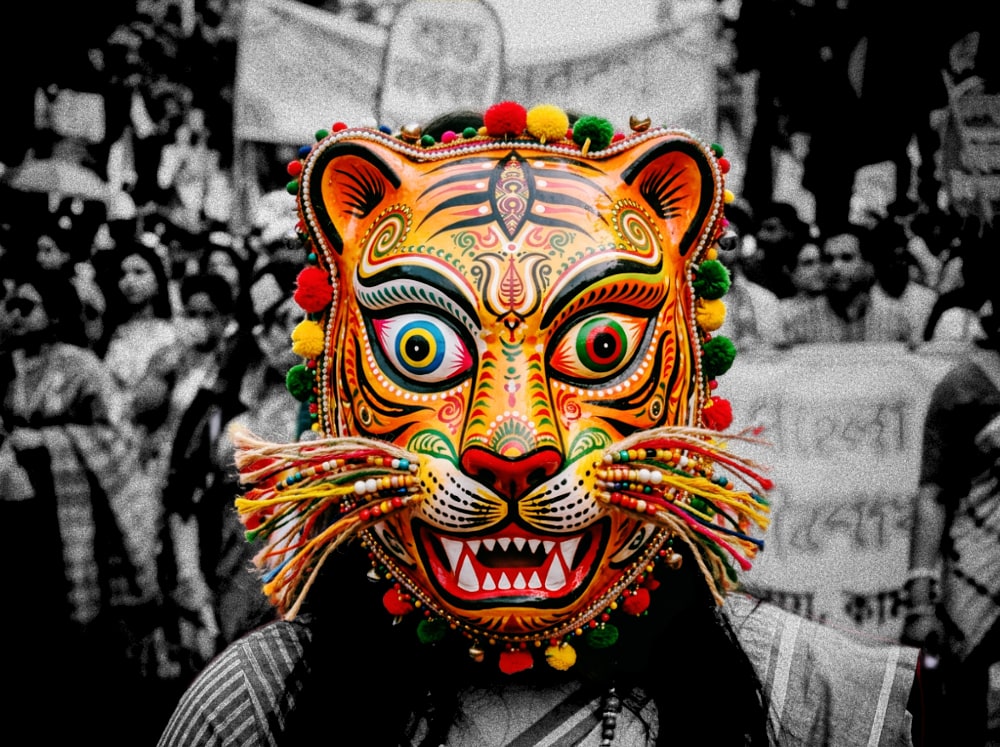
Pohela Boishakh in Bangladesh is usually described as a day of innocence: songs at Ramna Batamul, painted masks, bright saris, processions, renewal. But public culture in Bangladesh is rarely innocent. It is organised, curated and made to serve power. Over time, Pohela Boishakh, at least in its official Dhaka form, ceased to be only a festival and became a cultural instrument. It became a way for one elite class to present its own tastes, anxieties and political assumptions as the natural culture of the nation.
This transformation did not happen by accident. Institutions such as Charukola (the Faculty of Fine Art at the University of Dhaka) and Chhayanaut (the cultural organisation that hosts the annual dawn concert at Ramna) did more than preserve art and music. They helped construct an official cultural order. They shaped, in practice, what kind of Bengali could appear as enlightened, tasteful and civilised, and what kind would remain outside the frame: awkward, excessive, backward, suspect, or dangerous. What was presented as universal public culture was often the culture of a narrow urban elite, repeated so often that it hardened into common sense.
The annual procession, later elevated as the Mangal Shobhajatra, became one of the clearest expressions of this order. Its themes tracked the ideological needs of the Awami period with revealing precision. In 2012, as the state intensified its use of Liberation War memory and prepared the symbolic ground for the execution of Jamaat leaders, the slogan was “Rajakar-free Bangladesh, the inexhaustible Liberation War.” In 2014, after an election so hollow that even victory could not conceal its legitimacy crisis, the theme leaned toward courage and fearlessness, as though ritual might compensate for democratic emptiness. In 2021, when the Rapid Action Battalion’s record of abuses was under growing international scrutiny, the chosen line was: “In the guise of the dark and terrible, there comes beauty.” The pattern is difficult to miss. Public poetry appeared precisely when power needed moral camouflage.
The imagery was even more explicit. Again and again, the procession returned to the figure of the monster: dark, predatory, often visibly coded through beard, cap, weaponry and religious symbolism. One did not need to label the boat as the ruling order and the demon as Islamist or nationalist opposition. The public had already been trained to read the code. This was not neutral culture. It was symbolic pedagogy. It taught citizens who counted as enlightened and who counted as dangerous, who belonged at the centre of the national story and who could be aestheticised into darkness.
At that point, the claim that this was a universal social festival collapses. A genuinely public celebration must leave room for people it does not admire. Society includes the devout, the conservative, the provincial, the culturally unfashionable. But official Pohela Boishakh in Dhaka often did not gather society. It graded it. One section of Bangladesh appeared as luminous and fit for the future. Another appeared as dark, crude and threatening. This was not social unity. It was symbolic hierarchy.
And this is where one must examine carefully the word that Bangladeshi elites use with such confidence: secularism.
At its most defensible, secularism means something modest and necessary. The state should not belong to one religious doctrine, and citizens of differing beliefs should stand equal before the law. That is not controversial. But in Bangladesh, elite use of the term has often gone far beyond that. “Secularism” became a diplomatic and cultural credential. It reassured the West. It signalled to embassies, donors, NGOs and international institutions that the speaker belonged to the camp of moderation, progress and civilisation. It was, and remains, an excellent export word.
Inside Bangladesh, though, the same word has often done a different kind of work. It has functioned as a mask for contempt toward Islam too polished to name itself openly. This goes beyond opposition to theocratic coercion, which is legitimate. It is discomfort with Islam as public presence, historical confidence and social vocabulary. The beard becomes ominous. The cap becomes embarrassing. The madrasa accent becomes uncultured. Islamic symbolism becomes a problem of taste. Muslim historical memory is quietly downgraded, treated as something to be managed, softened, aestheticised, or supervised so that the nation may remain acceptable to elite sensibilities and foreign approval.
That is why secularism in Bangladesh often carries two meanings at once. To the West it says: we are pluralist, moderate and modern. At home it often means: we will decide how much Islam may appear in public life, in what form, and under whose control. This is not neutrality. It is hierarchy in polite language.
Official Pohela Boishakh became one of the most effective theatres for this hierarchy. It taught people how to recognise virtue by sight. The good citizen admired the right motifs, feared the right monsters, and recoiled from overt Muslim social confidence while still calling that recoil progress. The bad citizen could be rendered with economy: beard, darkness, vulgarity, reaction. This matters because before a state moves against political enemies through harder means, courts, prisons, disappearances, violence, it first prepares the symbolic ground. The opponent must become ugly before he becomes disposable.
Even the songs of renewal belong to this story. Each year the public is invited to celebrate cleansing: sweeping away refuse, burning off decay, purifying the earth through fire. These can be dismissed as harmless metaphors. But metaphors shape feeling. A public trained to experience purification as beauty may become more comfortable with purification in other registers too. What is old becomes rubbish. What resists becomes dirt. What embarrasses elite modernity becomes something to be burned away.
But what is old is not always refuse. Much of what is old is memory, continuity, inheritance. Bangladesh did not begin in a faculty courtyard. Nor did it emerge from donor language or UNESCO approval. Its life is layered, regionally textured, morally untidy, and deeply shaped by Muslim history. A culture that treats these inheritances as awkward or contaminating is not building a universal civic order. It is building a narrow class aesthetic and presenting it as the nation itself.
This is why UNESCO recognition of Mangal Shobhajatra as intangible cultural heritage felt, to many, less like honour than like misrecognition. Heritage in the language of international institutions is broad and bureaucratic. But oitihya (inheritance carried through generations) in the deeper Bengali sense implies continuity, transmission and rootedness. Not every recent, curated and politically loaded urban ritual acquires that depth because an international body approves it. A thing can be recognised without being rooted. It can be admired abroad without being deeply shared at home.
The change in naming from Ananda Shobhajatra to Mangal Shobhajatra is revealing. Joy is open. Auspiciousness comes with moral weight. The older name suggested a festival. The newer one suggested a rite whose legitimacy should not be questioned. The issue is not semantic. It is about authority. Who gets to define the meaning of the Bengali New Year? The people, in all their diversity, or a cultural clergy that has long claimed a monopoly on national taste?
The answer is not to abolish festivity. Bangladesh does not need less joy. It needs less monopoly over joy. Pohela Boishakh should be released from the guardianship of power. The state should step back. The old gatekeepers should lose their automatic authority. The festival should return, as far as possible, to society itself.
That means taking seriously the discomfort many ordinary Bangladeshis have long felt toward the monstrous and animal iconography used in a civic ritual meant to represent everyone. Their objection has too often been dismissed as ignorance. But democratic culture cannot be built on permanent contempt for majority moral instinct.
A different Pohela Boishakh is entirely possible: less demonology, more memory; less ideological allegory, more historical recognition. Let it reflect the many inheritances through which Bangladesh became itself: the figures associated with the Bengali calendar, the saints who shaped Bengal’s moral geography, the Sultanate and Mughal past, the struggle against colonial rule, the Language Movement, 1971, 1990, and the dead of more recent uprisings. Such a festival would still be political. All public memory is political. But it would at least abandon the old fraud by which one elite script alone claimed to be the nation’s universal culture.
More importantly, it would restore a truth that elite rhetoric has long tried to keep in embarrassed shadow: Islam is not an unfortunate residue in Bangladesh, nor an awkward sociological fact to be managed under the perfume of secular refinement. It is one of the constitutive realities of the country’s historical life. To say that is not to demand theocracy. It is to refuse falsification.
The larger issue is not Pohela Boishakh alone. It is the Bangladeshi habit of dressing power as culture and culture as innocence. Every elite wants its preferences mistaken for universality. The task of criticism is to interrupt that fraud and ask what has been hidden inside words like heritage, culture, progress and secularism.
Pohela Boishakh may yet survive that scrutiny. It may even become worthier because of it. But only if it stops functioning as an annual lesson in whom the nation is supposed to fear, aestheticise into darkness, or politely despise. Only if secularism, when uttered by Bangladeshi elites, is no longer treated as a virtue that certifies itself, but examined for the contempt toward Islam it has so often concealed. Only if the New Year stops serving as a managed accusation and returns as an occasion on which Bangladesh may meet more of itself than one class has so far been willing to permit.
The New Year should not belong to power. It should belong to the people whose memory, faith, grief, rebellion and continuity were edited out of the official script.
Only then would the mask begin to crack.
Only then might the festival become a beginning.