




Karl Marx remains one of those rare thinkers whose ideas did not interpret the world so much as rearrange it. Revolutions were waged in his name, states were built upon his vocabulary, and entire generations learned to see society through categories he introduced. A paradox persists: those who speak most confidently as his inheritors often appear least certain of what he meant.
The question, then, is disarmingly simple: what was Marx trying to say?
A certain suspicion may arise here. The gesture is familiar: an explanation that leans toward persuasion. One is reminded of a story from Bogura, a district in northern Bangladesh known more for its yogurt than its philosophers. Two brothers, notorious for their disinterest in mathematics, were placed under the care of an enthusiastic tutor. Finding them counting guavas in a tree, the tutor turned the exercise into an arithmetic problem. At once, the younger brother shouted up: Don’t answer: he’s teaching you maths. The warning may not be misplaced here.
Still, even if Marx is to be resisted, it is seldom wise to resist what one has not understood.
I. Recognition and Its Loss
What is called Marx’s theory of “alienation” risks sounding more abstract than the experience it describes. The condition is simpler and stranger: the familiar appearing as unfamiliar.
One might approach this through cinema. In an earlier essay, I had written about Surjakanya, a film by Alamgir Kabir, where a line from a song lingers with unusual insistence: Chena chena lage, tobu ochena; bhalobasho jodi, kache eshona (It feels familiar, and yet unfamiliar; if you love me, come closer, won’t you?).
At first hearing, the line seems to belong to the grammar of romantic distance. It admits another reading. The ambiguity it carries is not confined to love; it echoes, with surprising precision, the condition Marx describes.
The worker encounters the product of his own labour much like the lover in that song: something that feels recognisable, yet remains unowned. There is a trace of oneself in it, and no claim over that trace. The estrangement is a distorted proximity: close enough to suggest recognition, distant enough to deny it.
Beneath the lyric, one might hear a quiet appeal. If you are mine, if you have emerged from my hands, then come closer, so that I may know you, and in knowing you, recover myself.
Alienation, in this sense, belongs as much to feeling as to structure and cannot be reduced to either.
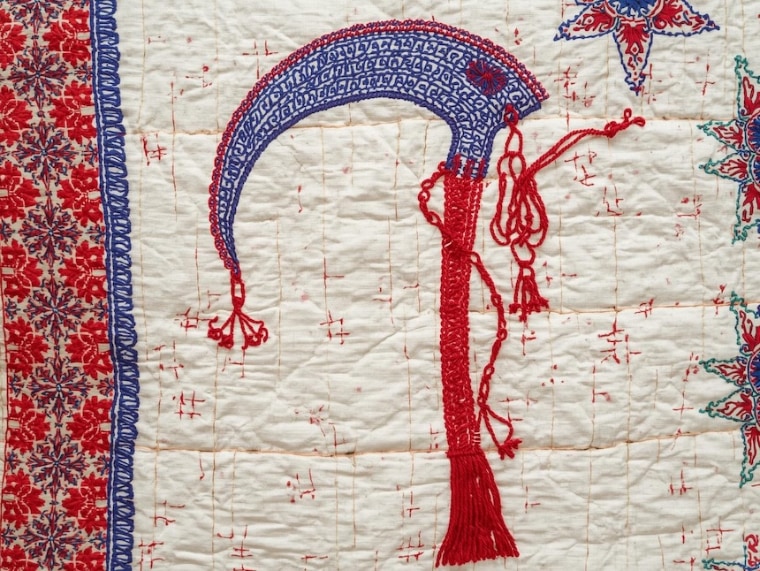
This was not always the case. In simpler forms of production, the maker could recognise himself in what he made. A grandmother stitching a nakshi kantha, a traditional quilted embroidery stitched from old cloth and layered with folk motifs, did not produce an object alone; she externalised memory, imagination, and care. The object returned that recognition. It completed a circuit between self and world.
Capitalism, in perfecting efficiency through the division of labour, breaks that circuit. Production becomes so fragmented that no individual can locate themselves within it. The worker contributes and cannot recognise the contribution. He labours and cannot see himself.
II. The Anxiety of Survival
A second difficulty follows. Capitalism renders livelihood precarious. Employment is contingent, subject to decisions made elsewhere, by people whose calculations are indifferent to individual lives.
The result is material insecurity and a condition of anxiety that runs beneath it. Human beings require income, yes, and also a sense of place: a recognition that their existence has use, that their presence is not accidental.
Capitalism offers neither. It produces a life lived in anticipation of dismissal, of replacement, of irrelevance. Life becomes uncertain, and then difficult to justify.
III. Value and Its Appropriation
A further tension emerges in the question of value. Workers are paid enough to continue and seldom enough to claim what they have produced. The surplus appears elsewhere, under another name.
Profit appears as creation and rests, more often than not, on appropriation. What appears as reward is inseparable from what has already been withheld.
One need not adopt the full architecture of Marx’s theory to recognise the intuition beneath it. A system that depends on minimising wages while maximising returns steadily narrows the distance between survival and insufficiency. Income persists; meaning thins.
IV. Crisis Without Scarcity
The instability of capitalism lies in a paradox. Its crises do not arise from scarcity. They arise from abundance.
Too much is produced; too little can be absorbed. The system, unable to absorb the value it has generated, turns against those who produced it. Workers are dismissed because their necessity cannot be accommodated, not because they have ceased to be necessary.
Capitalism does not falter from producing too little. It falters from producing more than it can recognise.
What might have become time, time for life beyond labour, reappears instead as unemployment. The promise of abundance is converted into its opposite.
V. Commodities and the Shape of Desire
This transformation extends beyond production into the texture of social life. Relations begin to take on the form of transactions. Love, marriage, and intimacy acquire the logic of exchange.
Marx described this as “commodity fetishism”: the tendency to attribute value to things while obscuring the relations that produced them. We begin by surrounding ourselves with objects, and end by mistaking objects for relations.
Where everything can be priced, little remains beyond price.
VI. The Quiet Work of Ideology
The durability of capitalism depends on belief as much as markets. It cultivates an ethos in which rest appears unproductive, leisure suspect, and wealth synonymous with happiness.
These assumptions are seldom imposed. They are absorbed. Individuals learn to inhabit a life that is restless, competitive, and detached: politically disengaged, yet structurally compliant.
The system organises expectation as much as it organises production.
Conclusion
One need not be a Marxist to recognise the force of these observations. They do not demand agreement; they ask for attention.
Understanding Marx does not require allegiance. It requires a certain honesty.
To understand capitalism without understanding its most systematic critic is to see half the picture.
And if, in the course of that understanding, something begins to feel familiar in an unfamiliar way, if one encounters, for the first time, a faint recognition of oneself in what had previously seemed distant, then one might recall the warning from Bogura. Don’t answer: he’s teaching you maths.